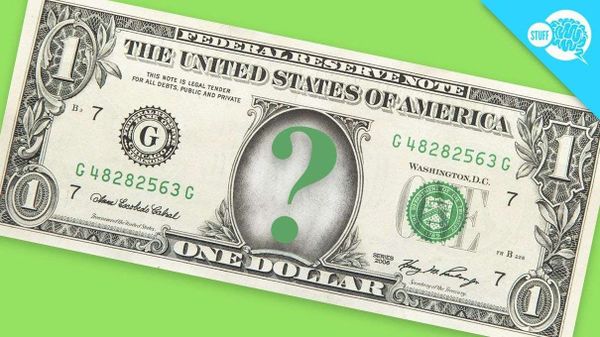
No doubt you're familiar with the U.S. $1 bill. You've likely seen it thousands and thousands of times, and it's probably one of the most recognizable pieces of currency in the world. You may even have a few in your wallet right now.
But how often have you really looked it over and wondered what's behind its design and symbols?
Advertisement
Well for one, they weren't chosen by chance. Like that portrait of George Washington. It hasn't always been on the dollar. The very first legal $1 tender was issued by the United States during the Civil War, and it featured a portrait of then-secretary of the treasury, Salmon P. Chase. Washington didn't get that honor until 1869.
Now what about all those other symbols?
Advertisement
The Front of the Dollar
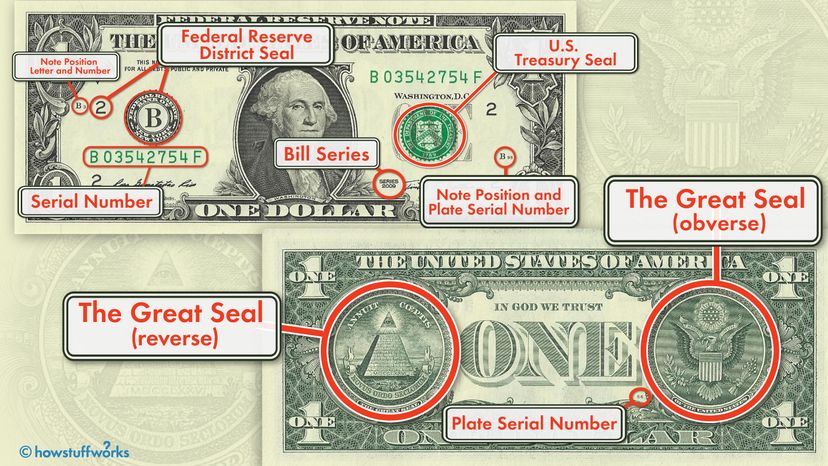
Let's start with the front of the dollar bill. It's the side that includes Washington's portrait. It features the Federal Reserve District Seal, the note position letter and number, the serial number, the U.S. Treasury Seal, the note position and plate serial number, and bill series. That's a lot of stuff! Let's break them down.
Today, every $1 bill has a Federal Reserve District Seal. It's a one- or two-digit number that appears in the corner of the bill four different times (this dollar shows a No. 2). The numbers indicate which Federal Reserve Bank actually printed the bill. A No. 2, for example, means it was printed in New York. The District Seal also includes the letters (in this case B) that specify the dollar's issuing Reserve Bank. New York is the Second Federal Reserve District and is designated by the letter B.
Advertisement
The note position letter and number is a combination of one letter and one number (on this bill it's B3) and simply denotes what position on the plate the bill was printed. The front of the $1 bill also includes its note position and plate serial number (B95). It identifies the actual engraving plate and its position on that plate. They appear on both the front and back of the dollar because different plates are used to print each side.
The front of the $1 bill also includes its serial number. This combination of 11 numbers and letters appears twice on the front of the note, and every dollar has a different serial number. The first letter of the serial number must match the letter in the Federal Reserve District Seal. If it doesn't, it's most likely counterfeit. This bill's serial number begins with B.
That last number you see on the front of the $1 bill is the bill series. It's between the portrait of Washington and the signature of the current treasury secretary. It's a year (on this bill it's 2009) but it doesn't actually indicate when the bill was printed. Instead it identifies the year when the design of this particular bill was implemented. New designs are issued when things change, like when a new secretary of the treasury takes office.
Finally, the U.S. Treasury Seal is depicted on the front of the $1 bill. The seal has remained relatively unchanged since 1789, and has arms depicting balance scales, a key and a chevron with 13 stars. The original seal, which was similar to the current design approved in 1968, was designed by Francis Hopkinson, a delegate to the Continental Congress.
Advertisement
The Reverse of the Dollar
The symbols on the flip side of the dollar hold a lot of meaning. They include both sides of The Great Seal of the U.S., as well as the bill's plate serial number.
Let's start there: The plate serial number (56) again simply identifies the actual engraving plate this side of the note was printed on. Remember, the front and back of the bill are printed using different plates, hence they have different plate serial numbers.
Advertisement
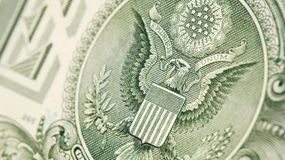
This extreme closeup shows the obverse of the Great Seal of the United States of America as featured on the $1 bill. The Founding Fathers took extreme care in choosing its symbolism.
zlisjak/Getty Images
Now onto the Great Seal. The seal dates back to the country's Founding Fathers. Before they adjourned the Continental Congress on July 4, 1776, they formed a committee — it included John Adams, Thomas Jefferson and Benjamin Franklin — to design a seal that would be symbolic of the new country's ideals. It wasn't until five years later, though, that the final design was approved by Congress. The seal's design is credited to Charles Thomson, who was a leading merchant in Philadelphia and secretary of the Continental Congress at the time.
Thomson's design includes lots of symbolism he and the Founding Fathers intended. The obverse, for instance, features an American eagle with a shield on its breast as the central figure. In the eagle's right talon is an olive branch, and in the left talon are bundles of arrows. In its beak the eagle is clutching a white scroll inscribed "E Pluribus Unum" (Latin for "Out of many, one"). Above the eagle is a crest that includes a constellation of 13 stars.
Thomson explained to Congress that the shield's blue horizontal band represents Congress, and its 13 red and white vertical stripes signify the 13 original colonies. The 13 stars above the eagle "denote a new state taking its place and rank among other sovereign powers." The olive branches and arrows, he said, "denote the power of peace and war, which is exclusively vested in Congress." Finally, he said, the motto, "E Pluribus Unum" alludes to the entire union as a whole.
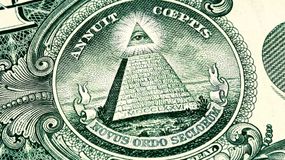
This extreme closeup shows the reverse of the Great Seal as featured on the $1 bill.
Rouzes/Getty Images
The reverse of the seal features an unfinished pyramid, which is made of 13 rows of building blocks; on the first row are the Roman numerals representing 1776. At the top of the pyramid is an eye and rays that radiate outward. Above the pyramid is the inscription "Annuit Coeptis" (Latin for "Providence Has Favored Our Undertakings"); below the pyramid it says "Novus Ordo Seclorum" (Latin for "A New Order of the Ages").
Thomson told Congress he chose a pyramid to symbolize strength and longevity, and the the eye and motto above to "allude to the many signal interpositions of providence in favour [sic] of the American cause." Thomson wrote the motto beneath the pyramid — "Novus Ordo Seclorum" — and the Roman numerals for 1776 as a way to honor the country's beginnings from that date.
Got all that? Good thing because the U.S. government has no plans of ever changing it. In fact, there's a law in place that prohibits the redesign of $1 bill. And we're glad because we have no intention of ever writing this article again.
Now That's Interesting
The largest denomination of U.S. currency is the $100 bill. The U.S. Federal Reserve did, however, once print a $100,000 Gold Certificate from Dec. 18, 1934, to Jan. 9, 1935, for transactions between Federal Reserve Banks.
Advertisement
Symbols on Dollar Bills FAQ
What is the worth of a one dollar star note?
How much you’ll get for it varies depending on where you sell it, but on eBay, a one dollar star note tends to go for upwards of five dollars.
How do I know if my star note is worth money?
To determine its value, you must factor in the age, condition, size of the print run, how many other star notes were printed in the run and how many other star notes exist in the same denomination.
Where do I locate the star on a dollar bill?
If a dollar bill has a star or asterisk, it will be at the end of the serial number printed on the bill.
What are star notes?
Star notes are replacements for originals that were either misprinted or unable to be used for another reason.
What is the rarest star note?
The two most rare star notes arethe series 1928B two dollar legal tender and the 1928 one dollar legal tender
Cite This!
Please copy/paste the following text to properly cite this HowStuffWorks.com article: