Effects of Predatory Lending
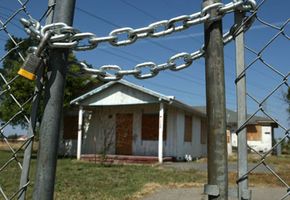
The result of predatory lending has been devastating, not only for the individual families, but for the entire United States economy. One in five subprime loans made during 2005 and 2006 will end in foreclosure [source: Center for Responsible Lending]. Foreclosures pull down the value of homes around them, robbing whole neighborhoods of crucial home equity and fueling the already catastrophic housing crisis.
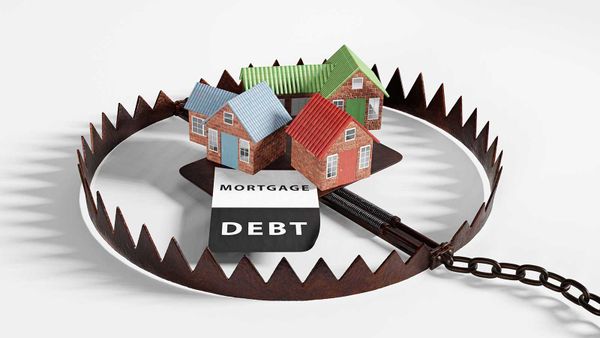
The main problem with predatory lending is that its effects aren't felt immediately. It can take three or four years for a borrower to realize that he or she can't afford a mortgage. That's because the borrower has been tricked into signing up for a so-called "exploding" mortgage. This is an adjustable rate mortgage (ARM) whose interest rate jumps from around 7 percent to as high as 12 percent after the second or third year of the loan. Exploding ARMs are also called "2/28" and "3/27" ARMS because the first two or three years carry a fixed interest rate, and the next 28 or 27 years of the mortgage carry a floating rate.
Why would anyone sign up for such a loan? Because the initial fixed rate, or teaser rate, is below the prime interest rate. And because the lender or mortgage broker convinces the borrower that within those first two years he can improve his credit score and refinance for a fixed interest rate before the adjustable rate resets, or "explodes" [source: Bair].
Part of the argument is that the house itself will grow in equity, allowing the borrower to take out a home equity loan to cover ballooning mortgage payments. But what happens when the housing market starts to drop? People actually lose equity in their homes and end up with nothing to help pay those skyrocketing mortgage payments.
According to a 2007 report by the Congressional Joint Economic Committee, 1.8 million subprime loans are going to reset during 2007 and 2008 [source: U.S. Congress Joint Economic Committee]. When an exploding ARM resets four or five percentage points, the monthly mortgage payment goes up an average of 29 to 50 percent [source: U.S. Congress Joint Economic Committee]. So if you were paying $2,000 a month, now you're paying $3,000. Most people can't afford that much of a leap. This is why there was a 90 percent increase in foreclosures on subprime loans from 2006 to 2007 [source: Center for Responsible Lending].
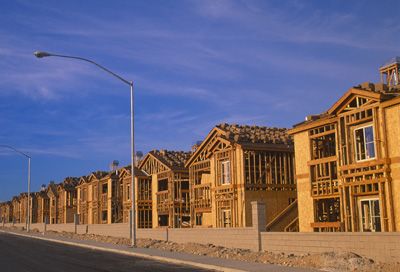
Foreclosures are bad news for everyone involved. A foreclosure can cost up to $80,000 split between homeowners, lenders, neighborhoods and local governments [source: U.S. Congress Joint Economic Committee]. And when several houses in a neighborhood are foreclosed, the prices of the surrounding homes begin to drop quickly. The Center for Responsible Lending estimates that 44.5 million American homes will lose an average of $5,000 in value in the next few years due to nearby foreclosures [source: Center for Responsible Lending]. That's $233 billion of lost home equity. And that's why it's called a housing "crisis."

Joe Raedle/Getty Images
Marcus West and Larry Heard take part in a protest by ACORN at Countrywide home loans center in October 2007. The nonprofit organization accused Countrywide of predatory lending practices.
Predatory lenders are not sleazy, small-time operators working out of the back of their vans. As recent lawsuits and settlements are showing, some of the worst predatory lenders are some of the biggest mortgage companies in the country. Countrywide and Ameriquest are two of the worst culprits. In multiple lawsuits, Countrywide employees have been accused of racial profiling, steering qualified borrowers into higher-interest subprime loans, bait-and-switch schemes, abusive and excessive fees and more. Ameriquest recently settled a class action predatory lending suit for $325 million [source: Phoenix Business Journal]. It turns out that these ill-conceived subprime loans are not only bad for borrowers, but for lenders as well. As of December 2007, 33.6 percent of Countrywide's subprime loans were delinquent and 17.3 percent were more than 90 days late, the limit for starting foreclosure proceedings [source: Center for Responsible Lending]. In addition, more than 90 subprime mortgage lenders went out of business by July 2007 [source: Center for Responsible Lending]. |
So how can you avoid getting swindled by predatory lenders? What are proven techniques for securing a safe loan? Read on to find out.