If you have looked at the most recent $20 bills from the U.S. Bureau of Engraving and Printing, you know that they have an army of security features designed to make counterfeiting more difficult. The most obvious of these features is the "20" in the lower right corner written in color-change ink, which will change color from copper to green when the bill is tilted. There's also a security thread embedded in the paper to the left of Andrew Jackson that is visible if you hold the bill up to the light. It reads "USA TWENTY" and includes a small flag. Other features include micro-writing, a watermark, which shows a faint image of Andrew Jackson to the right of the portrait, and very closely spaced lines (for example, behind Jackson's face) that are harder for a counterfeiter to reproduce.
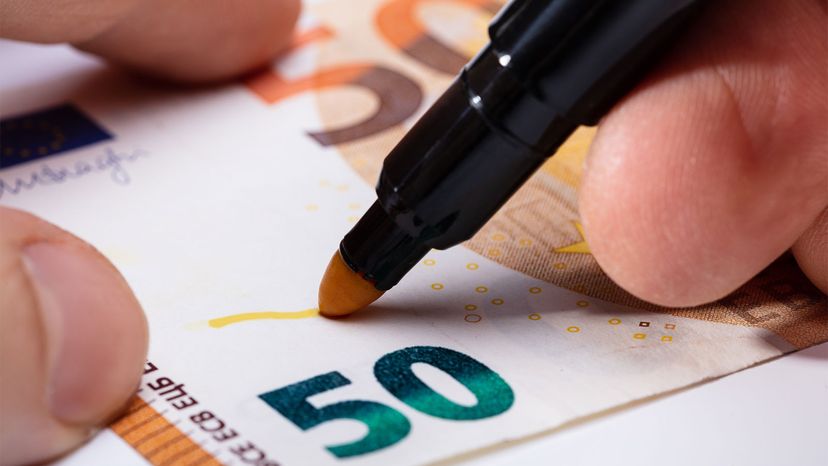
All of these features are nice, but no store clerk is going to stand and hold each $20, $50 or $100 bill he or she receives up to the light to check for a security strip. It simply takes too long — much faster and easier to make a pen mark and instantly see if it changes color. If it does, the bill in question is, indeed, counterfeit.
Advertisement
The counterfeit detector pen solves the biggest counterfeiting threat today. It used to be that a counterfeiting operation used expensive presses and special inks and papers to create exact duplicates of the bills. Today, the threat is much more mundane — people with color copiers and color printers try to create passable facsimiles of a bill. They are not trying to make an exact copy. They are trying to create something close enough that people won't notice anything if they give the bill a passing glance. These folks are not particularly careful or meticulous, so they copy or print onto normal, wood-based paper.
The counterfeit detector pen is extremely simple. It contains an iodine solution that reacts with the starch in wood-based paper to create a black, dark blue or brown stain. When the solution is applied to the fiber-based paper used in real bills, no discoloration occurs and the mark will remain pale yellow. The pen provides an easy and fast way to detect bills printed on normal copier paper instead of the fine papers used by the U.S. Treasury.
Is the Pen Foolproof?
Of course, counterfeiters will go to great lengths to try to fool simple technologies like the detector pen, since getting their hands on the type of starch-free paper used by the U.S. Bureau of Engraving and Printing isn't possible. One simple method is known as "bill bleaching," a process that nets the counterfeiter a blank piece of correctly sized currency paper which can then be overprinted with a higher denomination.
Here's how it works. The counterfeiter takes a real $5 bill and soaks it in a tray of heavy solvent, such as nail polish remover or another acetone chemical. This dissolves most of the ink, allowing the counterfeiter to then scrape off the rest with steel wool. The result is a blank piece of correctly sized currency paper which is then overprinted with a higher denomination, usually a $20, $50 or $100. The pen will therefore be fooled and detect that the doctored note is genuine currency.
So, while the counterfeit detector pen isn't a foolproof means of stopping counterfeiters, it is an easy tool for businesses to use as a first line of defense.
Advertisement