Labor Union Laws

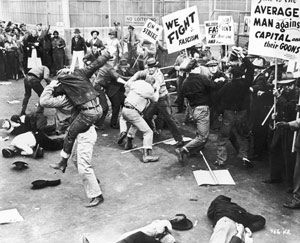
In 1935, Congress passed the National Labor Relations Act (NLRA) to “encourage a healthy relationship between private-sector workers and their employers” [ref]. Prior to the NLRA, employers were not required by law to recognize a union or to bargain in good faith. By establishing employees’ basic rights to join unions and engage in collective bargaining, Congress hoped to reduce work stoppages, strikes and other conflicts between labor and management that had all too often resulted in violence. The act also created the National Labor Relations Board (NLRB) as the organization to enforce the NLRA.

The NLRA accomplished three significant objectives:

  1. Allowed workers to have elections to decide if they want to be represented
  2. Established laws protecting employees from discrimination based on union- or group-related activity
  3. Created the NLRB as an administrative organization to enforce the law

Perhaps most importantly, the NLRA allowed unions to represent employees under the law. The act’s text states that it covers employees whose employers are involved in interstate commerce, but this is a broad definition, one that is easily applied. The act also outlined the basic rights for workers, something many had been lobbying about for decades. In addition to the right to union representation and participation, the NLRA allowed employees to engage in collective bargaining and protected concerted activities -- with or without a union -- that attempt to improve working conditions. The NLRA also granted employees the right to choose not not to take part in any of those activities, hopefully preventing unions or employers from exerting undue pressure on employees.

Some workers are specifically excluded from the protections of the NLRA:

  • Agricultural laborers
  • Domestic service workers
  • People employed by a parent or spouse
  • Independent contractors
  • Supervisors (supervisors who have been discriminated against for refusing to violate the NLRA may be covered)
  • Railroad and airline employees
  • Federal, state and local government employees
  • Employees of any entity that does not fit the NLRA’s definition of an employer
  • Confidential employees

The Taft-Hartley Labor Act
A significant number of strikes and increasing union power led Congress to pass the Labor Management Relations Act (LMRA) in 1947. Also known as the Taft-Hartley Labor Act, the LMRA amended parts of the NLRA. In order to stem the number of strikes, the LMRA enlarged the National Labor Relations Board, firmly establishing its control over labor disputes. It also authorized the government to get an 80-day injunction against any strike thought to be a danger to public health or security and outlawed union contributions to political campaigns.

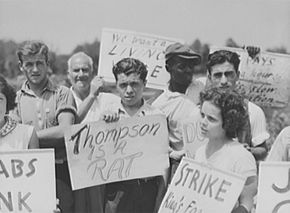
Significantly, the LMRA outlawed secondary boycotts. Secondary boycotts were a measure used in lieu of or in addition to a traditional strike. A union would set up a picket line at a company -- one with which the union did not have a labor dispute -- to pressure it to not do business with another company that was involved in a labor dispute with the union. For example, if brewery workers had a problem with their employer, they might set up a secondary boycott of the glass company that supplied bottles to their brewery, thereby putting pressure on the brewery by protesting against its supplier.


Photo courtesy John Vachon/Library of Congress Prints and Photographs Division
The LMRA allowed the federal government to exert more control over strikes in order to prevent disruptions to businesses vital to national health or safety. It also outlawed the practice of secondary boycotts.

Labor Management Reporting and Disclosure Act of 1959
As you can see, the mid-twentieth century was an important -- and busy -- time for labor legislation. The Labor Management Reporting and Disclosure Act (LMRDA) established a "Bill of Rights" for union members. The act was also passed because of a concern about union involvement in organized crime, a lack of transparency in union activities and a lack of democracy within unions. The LMRDA’s provisions include freedom of speech and assembly, protection from undeserved punishment, a vote in determing dues and fees, and the right to file suit and to participate in union activities.

Other clauses of the law include:

  • Requirements for reporting and disclosure by employers, labor relations consultants, union officers and employees and surety companies when engaging in certain activities
  • Rules for establishing and maintaining trusteeships
  • Safeguards for protecting union funds
  • Standards for conducting fair elections of union officers:
As we said before, one of the main goals of the LMRDA was to increase the level of democracy within unions. The law's changes to how unions run officer elections were intended to increase participation, communication and transparency. According to the LMRDA, all union members have to be notified by mail at least 15 days before every election. Candidates are allowed to examine a union's membership list -- but only once -- within 30 days of the election. Union and employer funds cannnot be used to promote any candidates. Actual elections must be held at least every three years. Voting is done by secret ballot and election observors must be permitted to monitor the proceedings.