Would you open a Swiss bank account? EThamPhoto / Getty Images
James Bond enters a Swiss bank in Spain and is frisked before he can meet with the banker. In the "Da Vinci Code," a triangular-shaped key activates a robotic arm that pulls a safety deposit box from the wall in a Swiss bank in Paris to ultimately reveal the secret to Christianity. The funny thing is neither of these scenes would actually happen in a real Swiss bank. There is no such robotic system and, while Swiss banks do have security, they don't search their clients before letting them access accounts. Most of us have formed ideas about what Swiss bank accounts are and how they work based on scenes like these that we've seen in the movies, read in books, or maybe even heard in the news. In other words, most of us have a distorted or mostly unrealistic view of what it really means to have the prestigious Swiss bank account. Let's dig deeper into Swiss Bank Accounts and see how they started, who can have an account and unlock the mystery.
Swiss bank accounts aren't just for millionaires, criminals or government officials trying to hide ill-gotten wealth, or celebrities protecting their assets from former spouses. They're available to anyone and lots of average people have Swiss bank accounts. People who live in countries with unstable governments and banks in particular often turn to Swiss banks because of their security and privacy.
Advertisement
But let's face it, most of us really just want to be able to say, "Oh, I'll wire the money from my Swiss bank account."
Your relationship with your Swiss bank can be compared to doctor/patient confidentiality or the private information you might share with an attorney. Swiss law forbids bankers to disclose the existence of your account or any other information about it without your consent (except for certain circumstances, which we'll discuss later). Where the similarity ends is when that privacy is violated. Whereas in the United States, if your doctor or attorney violates your confidence you must begin legal action; in Switzerland, if a banker divulges information about a bank account without permission, immediate prosecution is begun by the Swiss public attorney. Bankers face up to six months in prison and a fine of up to 50,000 Swiss francs. And, you have the option of suing the bank for damages. Needless to say, Swiss banks are very careful about protecting your privacy.
The only exceptions to the Swiss banking privacy rule are criminal activities such as drug trafficking, insider trading or organized crime, which we'll talk more about later.
Advertisement
Low Risk
So privacy is a big deal if you have money you don't want other people to know about, and unless you're a criminal it's highly unlikely anyone can ever find out about your account. For example, doctors who might be sued for malpractice might have money in a Swiss account to prevent them being totally wiped out in the event of lawsuit. Unethical, yes, but it happens. Really, anyone can have assets that they want to protect from attack. Sometimes, though, privacy isn't the main reason people want a Swiss bank account. Switzerland has had an extremely stable economy and infrastructure for many years and hasn't been at war with another country since 1505. Swiss bankers are also highly trained in investing and know how to grow your money.
Increasing your wealth means little if your money isn't protected. So, how safe is your money in a Swiss bank? Depositor protection in Switzerland is governed by the Swiss Bankers Association's (SBA) self-regulatory Depositor Protection Agreement and, since July 1, 2004, was also codified into the Swiss Banking Act with a few additional requirements that significantly strengthened depositor protection in Switzerland [Source: SwissBanking.org]. The revised Depositors' Protection Agreement covers all deposits and is also applicable to non-bank securities dealers. Protecting depositors is vital in maintaining public confidence in the Swiss banking system and, in order to strengthen this confidence, the SBA had drawn up a self-regulatory Depositor Protection Agreement with its member banks in 1984. This agreement guarantees that, in the event of a bank failure, depositors will rapidly receive their legally privileged claims. As an additional safety measure, Swiss law demands high capital adequacy. Swiss banks can therefore certainly be counted amongst the safest in the world.
In fact, the Swiss franc is considered one of the world's premier currencies with virtually zero inflation and has been historically backed by at least 40 percent gold reserves. Swiss banks are also known to have very sophisticated investment services and Internet banking.
Private vs. Retail Banking
Walk into the wrong Swiss bank and you'll be quickly escorted out and pointed in the direction of the bank you "should" be entering. What just happened? You've just walked into a "private" bank rather than a "retail" bank. Private banking refers to services provided by banks to private individuals with exceptionally large assets to work with. It's called "private" because customers receive a much more personal level of service than in mass-market retail banking. This historically exclusive service has been reserved for those with liquid assets over $1 million, although accepted deposits as low as $50,000 are not unheard of these days. The services you will receive at a private bank focus on private counseling in aspects of wealth management including investments, tax concerns, and estate planning. Many private banks require a special invitation or referral by current customers.
Retail banking, on the other hand, is your traditional mass-market banking system offering checking, savings, personal loans, mortgages and other types of accounts for individuals. While many retail banks also offer investment services, they're not on the level of those offered by private banks. When banking with a retail bank, customers work with local branches of larger commercial banks.
Advertisement
History of Swiss Bank Accounts
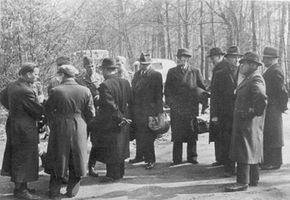
German Gestapo were ordered to follow Swedish Red Cross buses.
Courtesy of the Swedish Red Cross
For over 300 years, Swiss bankers have had a code of secrecy regarding banking and their account holders. It began with the kings of France who required strict secrecy, had high financial needs and had the ability to always pay back their loans.
Legislation about banking secrecy also dates back to this period. The Great Council of Geneva, in 1713, established regulations that required bankers to keep registers of their clients but prohibited them from sharing the information with anyone except the client-unless the City Council agreed with the need to divulge information.
Advertisement
This began Switzerland's long reputation as a safe haven for funds for noblemen fleeing the Revolution and others seeking financial asylum. Bank secrecy was regulated solely by civil law, enabling clients to lodge complaints for damages against any bank that didn't maintain confidentiality. However, no criminal charges could be placed so there was no threat of imprisonment for the banker who divulged information.
Until the turn of the century, provisions of the Swiss civil code and labor code provided a legal framework that supported bank secrecy. In order to survive twentieth-century financial upheavals such as the stock market crash of 1929 and subsequent depression, achieving legal recognition for bank secrecy was the only way the Swiss government could maintain its beliefs and refusal to interfere in the private affairs of its citizens. Switzerland's Banking Act of 1934 accomplished this goal. The law was enacted in large part because both Germany and France attempted to press Swiss banks into divulging depositor information in the name of the "good of the state." This federal law clearly stated that bank secrecy fell within the criminal domain, meaning any banker who divulged bank client information was punishable by imprisonment.
One issue of the time that reinforced the passage of this law came during the era of Hitler when a German law stated that any German with foreign capital was to be punished by death. Swiss banks were watched closely by the German Gestapo. It was after Germans began being put to death for holding Swiss accounts that the Swiss government was even more convinced of the need for bank secrecy.
In 1984, the people of Switzerland once again voted in favor of maintaining bank secrecy -- by a whopping 73 percent.
Nazi Gold
Many European Jews deposited their life savings in Swiss banks when WWII broke out during the 1930s and 1940s. And, after the war many were not allowed to recover their assets because their documentation was gone.
Swiss banks have come under fire in recent years because of their actions towards Jewish account holders after World War II and also because money that German Nazis plundered from defeated countries and their prisoners was held in Swiss banks. Christoph Meili, a former bank security guard, exposed the bank he worked for, saying that they destroyed records of people murdered in the Holocaust so that their money would not be returned to their heirs.
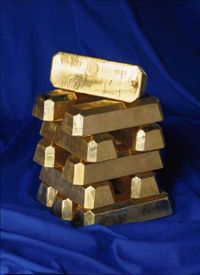
Gold ingots from Sveriges Riksbank.
Courtesy of Frederik/Jurema Oliveira
According to a report by Stuart Eizenstat on Nazi theft of Jewish assets, during WWII "between January 1939 and June 30, 1945, Germany transferred gold worth around $400 million ($3.9 billion in today's values) to the Swiss National Bank in Bern." It is believed that much of this gold was stolen from Jews and sent to Switzerland to be melted down and used to finance the war. According to Eizenstat, "Although there is no evidence that Switzerland or other neutral countries knowingly accepted victim gold ... at least a small portion of the gold that entered Switzerland and Italy included non-monetary gold from individual citizens in occupied countries and from concentration camp victims or others killed before they even reached the camps." This gold was deliberately mixed with other gold when re-smelted. It's assumed that the Swiss feared possible invasion from neighboring Germany.
After the war, to ensure that there could be no Nazi return to power, the Allies held or disposed of German external assets to prevent their return to German ownership or control. A plan was also made to take care of Nazi victims who needed aid. The Paris Agreement of 1946 provided that non-monetary gold recovered by the Allies in Germany and an additional $25 million from the proceeds of liquidating German assets in neutral countries would be transferred to the Intergovernmental Committee on Refugees.
The 1946 Allied-Swiss Washington Accord was held by the United States, United Kingdom and France. Switzerland was invited to discuss issues as a result of the Paris agreement. Under the Washington Agreement, Swiss negotiators agreed to transfer approximately 250 million Swiss francs ($58.1 million) of gold into the Tripartite Gold Commission's (TGC) monetary gold pool. In return, according to Eizenstat, the United States, United Kingdom and French governments agreed to "waive in their name and of their banks of issue all claims against the government of Switzerland and the Swiss National Bank in connection with gold acquired from Germany by Switzerland."
Recognized claims against the monetary gold pool greatly exceeded the amount of monetary gold actually recovered. So the TGC established a proportional redistribution system which established that each country would receive approximately 65 percent of its recognized claim.
The problem of dormant accounts and heirless assets was not directly addressed in the Washington Agreement. The head of the Swiss delegation did state, however, that his Government would "examine sympathetically" possibilities for making available for "relief and rehabilitation" proceeds of property found in Switzerland which belonged to (Nazi) victims . . . who have died without heirs." Although no action was taken until 1962 when a Swiss Federal Decree required banks, law offices, trustees and others to comb through records to discover dormant accounts belonging to foreign or stateless persons who were deemed victims of racist, religious or political persecution. As a result, a total of nearly 9.5 million Swiss francs (an approximate 1962 value of $2.4 million) was reported and about three-fourths was transferred to the rightful heirs. Of the remaining heirless assets, two-thirds were given to the Swiss Federation of Jewish communities and one-third to the Swiss Central Agency for Refugee Assistance.
The current investigation by the Swiss Bankers Association, begun in 1995, is the most recent attempt to find remaining dormant accounts and heirless assets. The investigations turned up approximately $32 million in 775 additional dormant accounts opened prior to 1945, though not all were of European origin.
An ad hoc task force known as the Historical Commission was established by the Swiss to determine what happened to assets transferred to Switzerland as a result of the Nazi regime. During this study, bank secrecy laws will be waived for a period of five years so the Commission can conduct a thorough study. The Swiss have indicated a three-to-five-year time frame for this study with the release of interim reports that will be submitted to Parliament. This will help resolve whether dormant accounts were used to satisfy Swiss business claims against central and eastern European countries which nationalized that property during the Communist era.
Advertisement
Swiss Bank Accounts and the Law
European Union flag
Public Domain
Regulations
In the United States, law enforcement agencies, the judicial system, and even private citizens can gain access to financial information of all sorts. In Switzerland, however, neither a bank's officers, nor employees are allowed to reveal any account or account holder information to anyone, including the Swiss government.
The Swiss banker's requirement of client confidentiality is found in Article 47 of the Federal Law on Banks and Savings Banks, which came into effect on November 8, 1934. The article stipulates that "anyone acting in his/her capacity as member of a banking body, as a bank employee, agent, liquidator or auditor, as an observer of the Swiss Federal Banking Commission (SFBC), or as a member of a body or an employee belonging to an accredited auditing institution, is not permitted to divulge information entrusted to him/her or of which he/she has been apprised because of his/her position."
Advertisement
Exceptions
In order to sidestep this law, there must be a substantial criminal allegation before a governmental agency, especially a foreign one, can gain access to account information. Tax evasion, for example, is considered a misdemeanor in Switzerland rather than a crime.
According to the Swiss Bankers' Association Web site, however, there is also a duty for bankers to provide information under the following circumstances:
Civil proceedings (such as inheritance or divorce)
Debt recovery and bankruptcies
Criminal proceedings (money laundering, association with a criminal organization, theft, tax fraud, blackmail, etc.)
International mutual legal assistance proceedings (explained below)
International mutual assistance in criminal matters
Switzerland is required to assist the authorities of foreign states in criminal matters as a result of the 1983 federal law relating to International Mutual Assistance in Criminal Matters. Assets can be frozen and handed over to the foreign authorities concerned. Assistance in criminal matters follows the principles of dual criminality, specialty and proportionality.
Dual criminality means that Swiss courts don't lift the requirement of bank/client confidentiality unless the act being investigated by the court is punishable under the law in both Switzerland and the country requesting the information. The specialty rule means that information obtained through the arrangement can only be used for the criminal proceedings for which the assistance is provided. The proportionality rule means the measures taken in conducting the request for assistance must be proportionate to the crime.
International mutual assistance in administrative matters
Under these proceedings, the Swiss Federal Banking Commission (SFBC) may communicate information only to the supervisory authorities in foreign countries subject to three statutory conditions:
The information given can't be used for anything other than the direct supervision of the banks or financial intermediaries who are officially authorized and can't be passed on to tax authorities.
The requesting foreign authority must itself be bound by official or professional confidentiality and be the intended recipient of the information.
The requesting authority may not give information to other authorities or to other public supervisory bodies without the prior agreement of the SFBC or without the general authorization of an international treaty. Information can't be given to criminal authorities in foreign countries if there are no arrangements regarding mutual legal assistance in criminal matters between the states involved.
Taxation
Swiss residents pay 35 percent tax on the interest or dividends their Swiss bank accounts and investments earn. This money is namelessly turned in to the Swiss tax authorities.
For nonresidents of Switzerland there are no taxes levied on those earnings, unless:
Swiss Withholding Tax
There is a 35 percent Swiss withholding tax on interest and dividends paid out by Swiss companies. So, if you invest in a Swiss company such as Nestlé or Novartis, then 35 percent of any dividends will be withheld as a tax regardless of where you live. The same is true if you buy bonds issued by a Swiss company. If you're a Swiss taxpayer (or if your country has a double taxation agreement with Switzerland) then you can claim the tax back. Double taxation is when income is taxed both in your home country, as well as the country in which the income is earned.
EU Withholding Tax
On July 1, 2005, the European Union Withholding Tax came into effect to prevent residents of EU member countries from avoiding paying tax on interest earned on money deposited in foreign banks with very strong banking secrecy laws. The EU goal had been for all countries to disclose interest earnings to the home countries of their bank clients so that that money could be taxed. Several non-EU countries, Switzerland included, didn't agree because it went against their banking privacy/secrecy laws. Now, bank clients who live in the European Union pay a withholding tax on the interest made by certain investments. This tax started at 15 percent and is gradually increasing to 35 percent by 2011. No exchange of information or taxes on capital or capital gains is levied.
Inheritance Tax
If you want to pass on your account to your family (and you're not a Swiss resident) you're in luck because there is no inheritance tax in Switzerland for nonresidents. Your heirs are responsible for declaring the holdings to their country's tax authorities, however.
Advertisement
Swiss Banks and Accounts
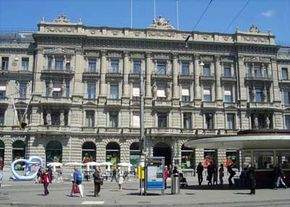
Credit Suisse bank in Zurich.
Courtesy of Sidonius Creative Commons Atribution-Share Alike License 2.5
The Swiss, and those banking in Switzerland, enjoy the benefit of having access to numerous bank types. Both a "universal" bank as well as a number of more specialized bank types make up the Swiss banking system. Swiss universal banks can provide all kinds of banking services for their clients from lending to asset management to traditional deposit accounts and financial analysis.
The "big 2"Of the 400 or so banks in Switzerland, the two largest are Union Bank of Switzerland (now called UBS AG after its merger in 1998 with Swiss Bank Corporation) and the Credit Suisse Group. These two banks together account for over 50 percent of the balance sheet total of all banks in Switzerland. You can find a directory of Swiss banks here.
Regional and localSwitzerland has many small universal banks that focus on lending and traditional deposit accounts. By restricting their business to one region they gain customer proximity, become more knowledgeable with local news and events and also with regional business cycles.
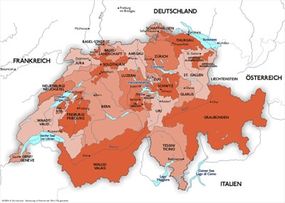
CantonalSwitzerland is made up of 26 official "cantons," or states. Currently, there are 24 Cantonal banks. Cantonal banks are either 100 percent-owned or majority-owned by the cantons and must be managed in accordance with proper business principles. Their history goes back more than a hundred years, offering low-cost loans and secure investment opportunities since the 19th century. Individual Cantonal Banks operate primarily in the market of their home canton. All the Cantonal Banks account for around 30 percent of banking business in Switzerland and have a combined balance sheet total of more than 300 billion Swiss francs.
Cantons of Switzerland
Courtesy of Mschlindwein GNU Free Documentation License
Raiffeisen GroupWith over 1,200 locations throughout the country (the highest number of branches), the Raiffeisen Group is Switzerland's third largest bank. Raiffeisen Group banks have strong local roots and have been around for more than a century. They are affiliated with the Swiss Union, which is responsible for the Group's risk management, coordination of the Group's activities, and framework for each individual banks' business activities, which enables the banks to focus on their true business-advising clients and selling banking services.
PrivateSwitzerland's private banks are individually owned, have collective and limited partnerships and are among the oldest banks in Switzerland. They focus primarily on asset management for private clients and do not publicly offer to accept savings deposits.
ForeignSwitzerland also has several foreign-controlled banks, meaning over half of the company's votes are held by foreigners with qualified interests. Ownership is predominantly held by nations of the EU (over 50 percent), followed by Japanese (around 20 percent).
About the Accounts
There are many levels of bank accounts. For Swiss residents, there are "current" accounts, which are useful for day-to-day management of your money, but pay little interest; "salary" accounts pay slightly more interest than current accounts, but without check writing capabilities and/or some other services; and "saving" accounts offer higher interest, but are not very useful for many transactions. Most nonresidents of Switzerland want Swiss accounts for their investment opportunities and privacy -- the more investment options and guidance you want, the higher the required balance.
Advertisement
Numbered accountsProbably the most noted and infamous Swiss bank account is the "numbered" account. As implied, these accounts have numbers associated with them (or sometimes a code word) rather than a name. Even so, there will always be a select few at the bank that must know the name that goes with the account. So, contrary to popular belief, there is no such thing as an "anonymous" Swiss bank account. Even though Swiss bankers must maintain silence regarding their clients and client accounts, there are always records of ownership.
Dormant accountsAs with anything that's "secret," you have to deal with what happens when one of the few people who know about it die. Accounts whose owners die without having passed on information to others concerning the existence of the account become dormant after a period of time. The account can be passed on to heirs but that becomes difficult if no one knows about it and the bank doesn't know you've died.Your banker could try to search for you, but that would "spill the beans" so to speak. After 10 years of no contact, however, the bank has a legal obligation to search for you. If they can't find you, or if they learn you have died, they will search for your heirs. If they can't find any heirs, they will report the account to the Swiss banking ombudsman, an official who represents the public by investigating complaints made by individual citizens.Therefore, it's important to take some measures to make sure your money goes to people you want it to. For example, give the banker another contact person that he can contact if he doesn't hear from you for a specific period of time (that person still doesn't have to know about the account). Or, you could have information about the account stored in a special envelope to only be opened when you die [Source: Swiss-Bank-Accounts.com].
A New Bank?
Most Swiss banks are very old -- some more than 200 years. It's still possible to start a private bank, but you'll need $7.25 million.
Advertisement
Opening and Using Swiss Bank Accounts
A passport is needed to open an account;a driver's license will not be accepted.
According to Swiss law, nonresidents of Switzerland who would like to open a Swiss bank account must be at least 18 years old. Other than that, there aren't a lot of restrictions. Your account can be in almost any currency, although most choose the Swiss franc, U.S. dollar, Euro or Sterling, and there is often no minimum balance required to open an account. Once you've started making deposits, however, there is a minimum balance you have to maintain that varies from bank to bank and by type of account.
Choosing a bank and an account
The Swiss bank you choose to deal with depends on what types of investments you want to make and the type of account you want have. One thing to keep in mind is unless you don't care about the privacy aspect of a Swiss bank account, you shouldn't choose a bank that has a branch in your country. Bank branches have to follow the laws in the countries in which they're located -- not where the corporate bank office is located. For example, a Swiss bank branch in the United States has no greater privacy capabilities than a regular U.S. bank does.
Advertisement
The type of account you open depends on the number of investments you want to have access to and the amount of money you want to maintain in the account. The more extensive the investment services and options are, the higher the required balance for the account. You can also have access to a safe deposit box at a Swiss bank.
Earning interest
If you maintain your account in Swiss Francs you will earn a small amount of interest, but will then have to pay the Swiss withholding tax. For this reason, most account holders that don't live in Switzerland have their Swiss bank account in some other currency such as U.S. Dollar, British Pound or Euro. When you do this, your money can be put into a money market fund and will earn interest there.
Opening an account
While it's usually better to open your account in person, there are many Swiss banks that will allow you to open an account by mail or fax. There are also many firms that exist to assist people in setting up offshore accounts.
Because Swiss anti-money-laundering law requires you prove where your money is coming from, many certified documents are required in order to open an account. These include authenticated copies of your passport; documents explaining what you do for a living such as tax returns, company documents, professional licenses, etc.; proof of where the money you are depositing is coming from such as a contract from the sale of a business or house; and all of the typical personal information about yourself such as your birth date, a utility bill to prove your residence, all contact information, and, of course, your name. They'll also want to know what you want to do with the money once you have the account.
If you're opening your account by mail, you'll need to have the bank applications sent to you to complete and sign along with the rest of the documents mentioned above.
One difference between opening an account in person and doing it by mail is the requirement of an apostille on the authenticated copy of your passport (and no, a driver's license won't be accepted as proof of your identity).
An apostille is a seal used to certify that an official document is an authentic copy. In most countries, you can get it from a notary public but sometimes notaries aren't familiar with them. If this happens you must either find another notary who is, or find out what other authority in your country can issue apostilles. Any country that participated in the Hague Convention designates an authority that can issue apostilles (e.g., in the United States, the office of the state's secretary is authorized to do this). The most important thing is to always make sure the seal says APOSTILLES.
Opening a numbered account
Numbered accounts are usually not as easy to open. They typically require that you physically go to the bank in Switzerland. They also typically require an initial deposit of at least $100,000 and cost about $300 per year or more to maintain. And remember, they're still not anonymous since there has to be a connection at some level between who you actually are and your account.
Minimum deposits/balances and fees
Minimum balances vary greatly by type of account (i.e., a few thousand dollars to one million dollars or more). And, banks charge differing fees based on the types of transactions and the account type you have. For example, on a basic account, international bank transfers (outgoing) might cost $3 or $4 each. They may also charge $5 to $10 when you deposit international checks to your account. Annual account maintenance costs are charged based on the number of entries in your account statement and are sometimes in the neighborhood of 0.5 Swiss Francs (i.e., $0.41) per entry.
Accessing Your Money
Credit card: Most Swiss banks will issue a credit card with your account that you can use to make purchases, as well as withdrawals at ATMs around the world. Cash advances, however, will charge a fee (usually 2.5 percent). Use of a credit card can also be traced back to your Swiss bank revealing the fact that you have the account. These credit cards are issued differently from typical credit cards, however. Rather than pulling a credit report and actually issuing true credit, Swiss banks require that you make a security deposit that is 1 to 2 times your monthly credit limit depending on the type of account you have. The security deposit itself is held in a separate account and invested.
Cash withdrawals: If you're in Switzerland you can walk into your bank and make a direct cash withdrawal, leaving no record of the access.
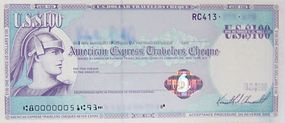
Travelers' checks: Buying travelers' checks is one way of using the money from your Swiss account and maintaining your secrecy. They're easy to use and widely accepted, but you will have to pay a 1 percent commission on the amount of the check.
Travelers Check from American Express
Courtesy of Valentin Wittich
Bank transfers: A simple way to use the money in your Swiss bank account is to request a bank transfer. But, again, you're essentially revealing the existence of your account, as well as your account number. To prevent revealing your account number and name, most Swiss banks will send money from your account in the bank's name without releasing your identity, but sometimes those types of transfers aren't accepted outside of Switzerland.
Checks: Swiss bank accounts do offer checking (except on numbered accounts). However, if you're after privacy, you're leaving a trail of breadcrumbs directly back to you. You lose the confidentiality most people want with a Swiss account and, therefore, checks are rarely used with these accounts.
Closing your account
You can close your Swiss bank account at any time with no restrictions or cost. You can get your money immediately and invested money as soon as it is liquidated.
Why Might You Not Be Accepted?
While the majority of applications for Swiss bank accounts are accepted, some aren't. Usually applications are rejected either because the origin of the money is questionable or unclear, or its origin goes against Swiss regulations. The strict money laundering laws have made scrutiny of money origins and subsequent deposits a high priority.
Advertisement
Swiss Bank Accounts, the United States and Beyond
There are no restrictions in the United States against having a Swiss bank account, or any other offshore account for that matter. But, current IRS regulations require U.S. persons to reveal all foreign accounts when they file their annual income tax if more than a total of $10,000 is held in overseas accounts.
Additionally, as a U.S. citizen, green card holder or other subject to U.S. tax, if you invest in American securities through a Swiss bank account, you must declare it to the IRS.
Advertisement
This regulation doesn't apply to any other securities, so if a U.S. person buys British stocks from his or her Swiss bank account they will not pay any tax in Switzerland and will continue to enjoy Swiss bank secrecy.
Other "Secret" Banks
There are a number of countries with banks offering secrecy and "tax havens." The most common ones include:
Anguilla
Anguilla is a British territory in the Eastern Caribbean. It's considered an offshore business center and a tax-free zone.
Belize
Belize has offered offshore banking since 1995. Accounts maintained with these banks are not subject to local taxes and their customers are given privacy concerning their account. If the Belize courts find that funds are coming from criminal activity, however, the banks are required to release the identity of the account owner.
Bahamas
Banking secrecy in the Bahamas is not as strong as other countries that offer it. New banking legislation allows banks in the Bahamas to divulge the fact that a particular person or company has an account with that bank.
Cayman Islands
The Cayman Islands have extensive privacy laws related to banking, and, like Switzerland, officials that break the secrecy law face imprisonment.
Panama
Panama is seen by many as a very stable country offering bank privacy.
For lots more information on Swiss Bank Accounts and related information, check out the links on the following page.
United States/Switzerland Information Sharing Agreement
On January 24, 2003, the United States and Switzerland agreed to facilitate the exchange of tax information in an effort to ensure that no safe haven exists for funds associated with illicit activities, including tax evasion.
This requires Swiss banks to turn over account and accountholder information in the event that U.S. officials suspect tax fraud. Part of the agreement states: "It is understood that, in response to a request, the requested State shall exchange information where the requesting State has a reasonable suspicion that the conduct would constitute tax fraud or the like. The requesting State's suspicion of tax fraud or the like may be based on:
Documents, whether authenticated or not, and including but not limited to business records, books of account, or bank account information;
Testimonial information from the taxpayer;
Information obtained from an informant or other third person that has been independently corroborated or otherwise is likely to be credible; or