The 5 Smallest Economies in the World Are All Island Nations

By: Jasper Merrenor  | 
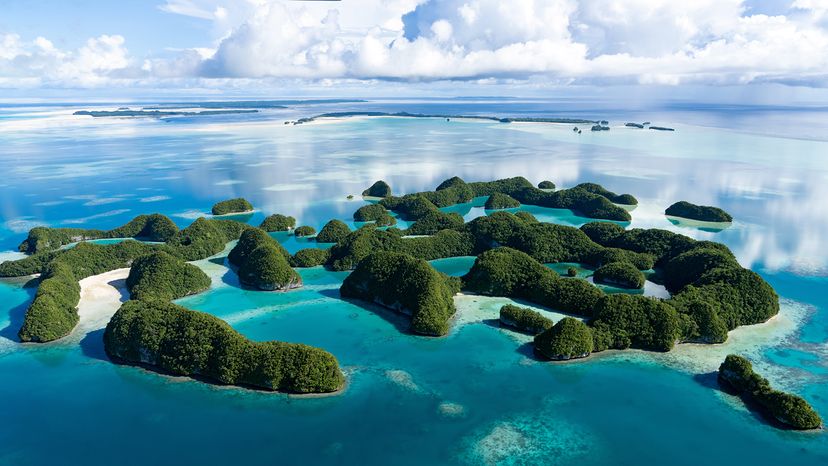
You can see why tourism is one of the biggest drivers in Palau's economy. Fidelia AZ / Shutterstock

Ranking the smallest economies in the world sounds simple, but it opens a window into how the global economy really works. When you rank smallest economies by nominal GDP, you are looking at gross domestic product at current prices, not quality of life, political stability, or human resilience.

That matters because the world's smallest economies are usually sovereign countries with small resident populations, tiny domestic markets, and a narrow export base. Most are island nations, and both these factors make economic growth harder to sustain.

Advertisement

Below is a look at the five smallest economies, plus a few close neighbors and the bigger forces that shape them.

1. Tuvalu Has the World's Lowest Nominal GDP

Among sovereign countries, Tuvalu sits at No. 1 when analysts rank the smallest economies in the world by nominal GDP.

IMF estimates place Tuvalu's 2025 GDP in the tens of millions of dollars, with some tables landing near $65 million and others pushing closer to $79 million, depending on current prices and revision timing.

Advertisement

That tiny GDP size belongs to an island republic with a population of roughly 10,000 to 11,000 people. In practical terms, the entire population is small enough that writers sometimes compare it to one cruise ship.

Tuvalu's government makes money in creative ways. One of the best-known examples is its .tv internet domain, which the nation leases because the suffix is valuable to media and streaming companies.

On top of that, Tuvalu's economy relies on tuna-fishing licenses, grants, and other forms of foreign aid, because a limited economy with few natural resources leaves little room for large-scale industry.

Advertisement

2. Nauru Runs on Fishing, Phosphate and Australian Payments

Nauru is usually ranked No. 2 among the world's smallest economies in 2025. Its estimated GDP also shifts a bit across datasets, but it generally lands around $169 million to $179 million.

This island nation has a population of about 12,000 people and a long history of phosphate extraction. In older decades, a thriving phosphate mining sector made Nauru unusually wealthy for its size. Today, the main primary economic sectors are narrower: tuna-fishing licenses, residual phosphate activity, and the public sector.

Advertisement

Another major revenue source has come from Australia's offshore processing center, also called the Regional Processing Centre or regional processing centre, built to hold asylum seekers for the Australian government.

That arrangement has brought in over AU$5 billion for the Nauruan government since 2001, but it also shows how a narrow sector can dominate a national economy almost overnight.

Nauru is one of the clearest examples of how small populations, remote areas, and limited natural resources can lock a nation into a narrow export base.

Advertisement

3. The Marshall Islands Depends on Compact Money and Tuna

The Marshall Islands is generally the third entry when countries by GDP are ranked from smallest upward. Its estimated GDP is commonly placed just under or just over $300 million, with recent estimates clustering around $294 million to $297 million.

Its population is roughly 38,000 to 42,000 residents, depending on which official count you use. That is still tiny by world standards, but much larger than Tuvalu or Nauru.

Advertisement

The economy of the Marshall Islands is driven largely by public sector activity financed through U.S. payments under the Compact of Free Association. Tuna fishing also matters, and marine resources are among the country's most important natural resources.

Even so, this is still one of the smallest national economies on Earth, with limited room for large manufacturing or a deep consumer base.

Advertisement

4. Kiribati Stretches Across Tiny Islands and a Narrow Economy

Kiribati's nominal GDP is projected at about $312 million.

It consists of 33 coral islands spread across a vast area of Oceania. The Pacific Ocean covers approximately 63 million square miles, so even very small countries can be scattered across positively massive distances.

Advertisement

The country has a population of roughly 120,000 to 135,000 people, and its economy is funded largely by overseas grants, remittances from seafarers, and tuna-fishing licenses.

Those revenue streams matter because the country has a small domestic market, few natural resources, and high freight costs that make imports more expensive.

Kiribati also shows why climate change is not just an environmental issue; it's an economic one. In small island states, stronger storms, flooding, and saltwater intrusion can hit housing, roads, fishing, and tourism all at once.

Advertisement

5. Palau Looks Bigger, but It Is Still One of the Five Smallest Countries

Palau rounds out the five smallest countries by GDP. Its estimated GDP is about $333 million, though Palau numbers move around as tourism rebounds and forecasts are updated.

Palau has a population of around 18,000 people. Compared with Tuvalu, that can sound positively massive, yet it is still a very small economy. Some writers joke that Tuvalu's carrying capacity feels like one cruise ship, while Palau is closer to approximately two cruise ships.

Advertisement

Palau's economy is driven largely by tourism—especially scuba diving—along with fishing. That makes it a classic island nation case: beautiful, globally connected, and highly exposed to outside shocks. When travel demand falls, a country this small feels it fast.

The service-heavy structure also means the public sector remains important. Palau is not isolated from the world economy, but it has fewer buffers than the world's largest economies.

Advertisement

The Federated States of Micronesia Sits Just Above the Bottom Five

The Federated States of Micronesia does not usually make the list of smallest economies, but it is close. Its 2025 nominal GDP is projected at about $500 million, and its population is about 113,000 people.

Like the Marshall Islands, the nation operates under a Compact of Free Association with the United States. Government spending financed by U.S. grants plays an outsized role in the economy, which helps explain why the public sector matters so much in several Pacific economies in the world.

Advertisement

This is where ranking can get tricky. A country may have more people than Tuvalu or Palau but still remain among the smallest economies because production is concentrated in a few sectors and transport costs stay high.

Why Small Economies Stay Small

Small economies often experience the same basic problem: They do not have enough people or enough local demand to build a broad industrial base. Small populations limit internal consumption, and that means businesses have fewer chances to reach the scale that lowers costs.

That is why many small economies have limited industrialization and rely on a few primary economic sectors such as fishing, agriculture, government services, or tourism. When imports are expensive and labor markets are thin, a domestic manufacturer has a hard time competing.

Advertisement

Isolation makes this worse. In remote areas, a container of fuel, cement, or food can cost far more than it would in a continental market. Small economies often have a high dependency on imports for food and fuel, so freight becomes part of the economic story.

In a world counting countries by GDP, it is easy to miss smaller economies because the headlines focus on the United States, China's role as the world's second-largest economy, the European Union, South Korea, and other emerging markets.

Some datasets also include labels such as Taiwan Province of China, while countries like North Korea remain hard to compare because of data unavailability.

Advertisement

Tourism Helps, but It Can Turn Volatile Fast

Tourism is a lifeline for many of the economies in the world that sit near the bottom of the GDP table. Palau is the clearest case here, but Dominica offers another useful example.

Dominica has tried to diversify by building an eco-tourism sector and by using a citizenship-by-investment program to bring in capital. That kind of strategy can help a small country broaden revenue sources when agriculture alone is not enough.

Advertisement

Still, tourism is volatile. A recession in the global economy, a pandemic, coral reef damage or a major storm can slash arrivals in one season. For countries with small resident populations, that kind of drop can ripple through hotels, restaurants, fishing, retail, and tax revenue all at once.

The same logic helps explain why Saint Kitts and Nevis—another small island state—can take a big hit when tourism or financial flows weaken.

Advertisement

Climate Change Is a Direct Economic Threat

Small Island Developing States, often called SIDS, face existential risks from climate change. Some disasters in island states have caused damage exceeding 50 percent of annual GDP in a single event, which is the fiscal equivalent of a household losing half its yearly income overnight.

That vulnerability comes from several factors combine into one problem. Many of these countries are low-lying, heavily coastal and dependent on a few sectors. So when climate change hits fisheries, airports, roads, freshwater, or reef tourism, it hits both production and government budgets.

Advertisement

This is why foreign aid remains so important. Many small economies depend heavily on external assistance to keep basic services running, rebuild after storms and invest in adaptation. Without that support, economic growth can stall for years.

GDP Rankings Are Useful, but They Miss a Lot

GDP rankings tell you how much a country produces, not how well it governs, how safe it is from disaster, or how resourceful its people are. That is why the smallest countries are not necessarily the weakest countries.

Tuvalu found value in an internet domain. Nauru turned to fishing access, phosphate, and payments linked to people sent there to hold asylum seekers. The Marshall Islands and Micronesia rely on free association arrangements. Kiribati pulls income from grants and remittances. Palau leans on divers, reefs and fishing.

Those are all creative ways to keep very small sovereign countries functioning inside a global GDP system built around much larger players.

The five smallest economies can shift slightly from year to year as prices move, tourism recovers, or data revisions roll in. The order can wobble at the margins, but the basic picture stays the same: All these islands operate under tight constraints.

We created this article in conjunction with AI technology, then made sure it was fact-checked and edited by a HowStuffWorks editor.

Advertisement

Loading...