Take the Quiz Think you're an expert on money laundering? Test your knowledge with this quiz from Investigation Discovery:Money laundering quiz |
In October 2005, U.S. congressman Tom DeLay was indicted on money laundering charges, forcing him to step down as House Majority Leader. Money laundering is a serious charge -- in 2001, U.S. prosecutors obtained almost 900 money-laundering convictions with an average prison sentence of six years. The rise of global financial markets makes money laundering easier than ever -- countries with bank-secrecy
laws are directly connected to countries with bank-reporting laws, making it possible to anonymously deposit "dirty" money in one country and then have it transferred to any other country for use.
Money laundering happens in almost every country in the world, and a single scheme typically involves transferring money through several countries in order to obscure its origins. In this article, we'll learn exactly what money laundering is and why it's necessary, who launders money and how they do it and what steps the authorities are taking to try to foil money-laundering operations.
Money Laundering Basics
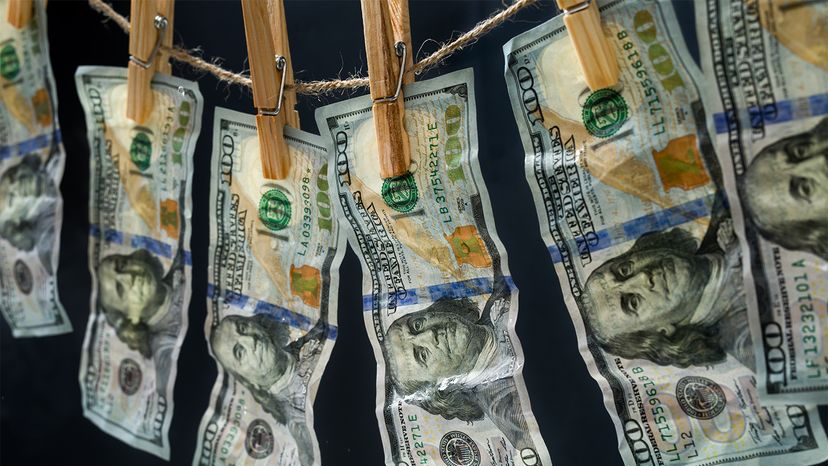
Money laundering, at its simplest, is the act of making money that comes from Source A look like it comes from Source B. In practice, criminals are trying to disguise the origins of money obtained through illegal activities so it looks like it was obtained from legal sources. Otherwise, they can't use the money because it would connect them to the criminal activity, and law-enforcement officials would seize it.
The most common types of criminals who need to launder money are drug traffickers, embezzlers, corrupt politicians and public officials, mobsters, terrorists and con artists. Drug traffickers are in serious need of good laundering systems because they deal almost exclusively in cash, which causes all sorts of logistics problems. Not only does cash draw the attention of law-enforcement officials, but it's also really heavy. Cocaine that's worth $1 million on the street weighs about 44 pounds (20 kg), while a stash of U.S. dollars worth $1 million weighs about 256 pounds (116 kg).
Tom DeLay
In October 2005, a Texas county indicted U.S. congressman Tom DeLay on charges that included money laundering and conspiracy to violate election codes. (The conspiracy charge was later thrown out, and as of May 2006 no trial date has been set.) In Texas, candidates for legislature are not allowed to receive corporate campaign donations. The prosecution holds that DeLay took part in an alleged scheme to bypass that rule and hide the corporate origins of money that ended up in the hands of Republican candidates in Texas. The alleged laundering scheme involved sending corporate donations from Texas to the Republican National Committee headquarters in Washington D.C., and the RNC then sending an equal amount of money back to Texas for use in campaigning. Two of DeLay's aides and his top campaign contributor have already pleaded guilty in a separate probe to crimes including conspiracy; wire, tax and mail fraud; and corruption of public officials.
|
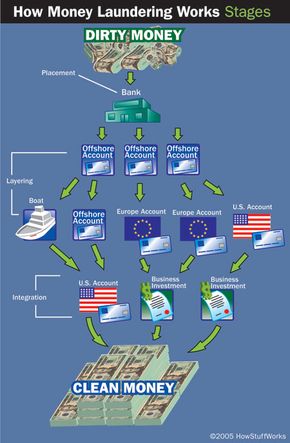
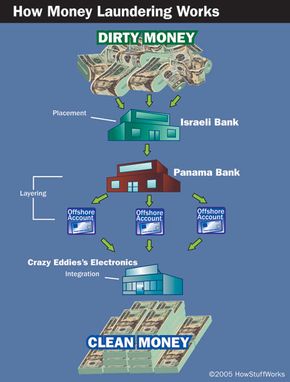
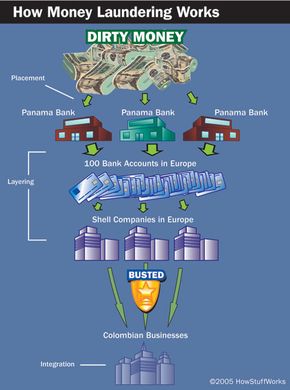
The basic money laundering process has three steps:
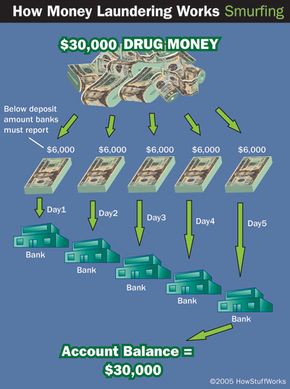
- Placement - At this stage, the launderer inserts the dirty money into a legitimate financial institution. This is often in the form of cash bank deposits. This is the riskiest stage of the laundering process because large amounts of cash are pretty conspicuous, and banks are required to report high-value transactions.
- Layering - Layering involves sending the money through various financial transactions to change its form and make it difficult to follow. Layering may consist of several bank-to-bank transfers, wire transfers between different accounts in different names in different countries, making deposits and withdrawals to continually vary the amount of money in the accounts, changing the money's currency, and purchasing high-value items (boats, houses, cars, diamonds) to change the form of the money. This is the most complex step in any laundering scheme, and it's all about making the original dirty money as hard to trace as possible.
- Integration - At the integration stage, the money re-enters the mainstream economy in legitimate-looking form -- it appears to come from an legal transaction. This may involve a final bank transfer into the account of a local business in which the launderer is "investing" in exchange for a cut of the profits, the sale of a yacht bought during the layering stage or the purchase of a $10 million screwdriver from a company owned by the launderer. At this point, the criminal can use the money without getting caught. It's very difficult to catch a launderer during the integration stage if there is no documentation during the previous stages.

|
Money laundering is a crucial step in the success of drug trafficking and terrorist activities, not to mention white collar crime, and there are countless organizations trying to get a handle on the problem. In the United States, the Department of Justice, the State Department, the Federal Bureau of Investigation, the Internal Revenue Service and the Drug Enforcement Agency all have divisions investigating money laundering and the underlying financial structures that make it work. State and local police also investigate cases that fall under their jurisdiction. Because global financial systems play a major role in most high-level laundering schemes, the international community is fighting money laundering through various means, including the Financial Action Task Force on Money Laundering (FATF), which as of 2005 has 33 member states and organizations. The United Nations, the World Bank and the International Monetary Fund also have anti-money-laundering divisions.