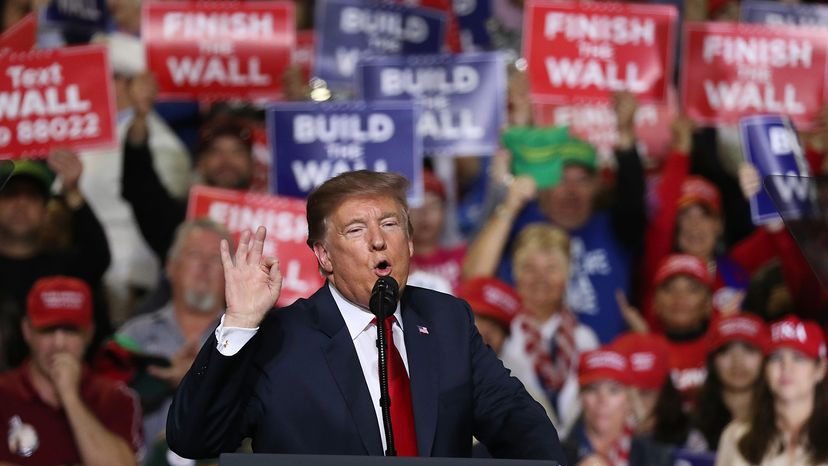
The power of eminent domain is founded in the Fifth Amendment to the U.S. Constitution, a bit of Bill of Rights muscle that gives government the right to take private property for the public good. If you visit your childhood home only to find it's been replaced by a strip mall or widened road ... that may be eminent domain at work. When President Donald Trump decided to build a wall on the U.S.-Mexico border in 2019 — much of it cutting through private property — eminent domain issues, and lawsuits attempting to stop the wall, immediately sprung up.
The Fifth Amendment states that private property can be taken for public use as long as just compensation is given. That means, as long as a fair price is established, roads, courthouses, schools and utilities can be erected on the land a private home or business already sits on. Sometimes, private commercial development that's considered a benefit to the community can be built on somebody else's land, too.
Advertisement
In the early days eminent domain was mainly used to support large-scale public works operations. The growing freeway system after World War II is a good example of how government used eminent domain to accomplish necessary development for the good of the country.
Through the years, though, eminent domain has remained a thorny legal issue pitting the rights of the individual against the rights of a government that is working, at least theoretically, for the greater good.
In the early 1980s, a Michigan Supreme Court ruling allowed more than 1,000 homes and 600 businesses to be razed to make way for a General Motors auto plant. The town where the plant was built didn't experience the economic boom developers expected. In what can only be considered a "too little, too late" decision, the high court reversed the GM ruling more than 20 years after the homes and businesses were torn down [source: PBS].
Using eminent domain for schools, roads and courthouses has given way to developers looking to build condos and outlet malls. The Supreme Court weighed in with a landmark decision in 2005 that has paved the way for even more wide-reaching definitions of "public good."
In this article, we'll explain the eminent domain process and examine some abuses of the powers.
Advertisement