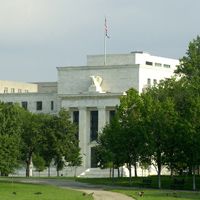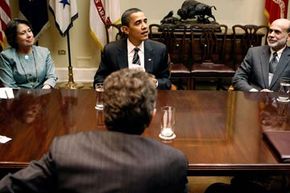
Accompanied by acting FDIC chairman Martin Gruenberg (far right) and members of Congress, President Bush signed the Federal Deposit Insurance Reform Conforming Amendments Act of 2005 on Feb. 15, 2006. See more banking pictures.
Getty Images
Introduction to How the FDIC Works
If you bank in the United States, you've probably seen the sticker posted on the door of your bank: FDIC. Maybe you've taken the time to expand the acronym: Federal Deposit Insurance Corporation. Maybe you've read the sticker's little assurance: "Each depositor insured to at least $100,000."
But what is the Federal Deposit Insurance Corporation? Where did it come from? How does it work? What does its insurance cover? To understand why the FDIC was created and how it works, it helps to understand the basic premises of insurance.
Insurance is like gambling. When you buy an insurance policy, whether it's auto, life or medical insurance, the insurance company assesses the risk of insuring you by asking questions like, what's the likelihood that a driver of a certain age and driving history is going to get into a fender bender? What's the likelihood that a woman of a certain age and medical history is going to accrue serious medical costs? What's the likelihood that employees working in a warehouse filled with dangerous machinery are going to get hurt?
If you're considered a low risk, the company will charge you a relatively low premium, a fee you pay for the insurance coverage. If you're considered a high risk, the company will charge you a high premium, or -- if you are a truly bad gamble -- choose not to cover you at all.
The premiums you pay go to the insurance company's insurance fund, which the company uses to pay an insured member when his car gets sideswiped or he hits his head on a forklift.
The FDIC's depositor insurance is, in principle, no different from any other insurance. Instead of insuring cars and workers, however, the FDIC insures people who hold deposit accounts with U.S. banking institutions.
For how long has the FDIC been around? How did it come to exist in the first place? Take a look at the next page.
The sorrowful faces of the life-size statues are a powerful expression of the times, showing the inactivity and troubles of everyday citizens during the Great Depression.
AFP/Paul J. Richards
What Is the FDIC?
When the Great Depression hit the United States in the late 1920s, banks collapsed like houses of cards. How did this hurt consumers? When the banks failed, they lost their customers' money. Failed banks lost an estimated $1.3 billion of consumers' deposited money between 1929 and 1933.
To help rectify the situation, President Franklin D. Roosevelt signed the Banking Act of 1933, which, among other things, created the Federal Deposit Insurance Corporation. The primary purpose of the FDIC was to ensure that consumers who banked with an insured bank didn't lose their money if the bank curled up and died. For this insurance coverage, banks paid a flat-rate premium of $2,500 per depositor, which increased to $5,000 soon after the FDIC's founding. Although certainly no panacea for the Great Depression, this insurance helped to restore consumer confidence in banking institutions.
Other major events in the FDIC's history include:
- The Federal Deposit Insurance Act of 1950 boosted insurance coverage to $10,000 per depositor. This law also authorized the FDIC to invest money in (or "bail out") a failing U.S. bank, if the bank's failure would cause serious economic turmoil in the community it served. Without a bank to invest in business and community development, a city or region can be left financially impaired or devastated. The FDIC usually uses the term "too big to fail" to describe such financial institutions.
- The Depository Institutions Deregulation and Monetary Control Act of 1980 increased the FDIC's insurance coverage to $100,000 per depositor.
- The Federal Deposit Insurance Corporation Improvement Act of 1991 changed the flat-rate premium paid by insured banks to a risk-based premium, as with health insurance and auto policies. In the 1980s, years of recession saw massive bank failures in the U.S., especially among savings and loan institutions. The FDIC spent billions of dollars to bail out banks it deemed "too big to fail," but some of these banks ended up failing anyway. To prevent the FDIC from wasting money on unwise bailouts, this Act requires Presidential approval of any bailout.
What if I have more than $100,000 in my Account?
As it sells off a failed bank's assets and loans, the FDIC will distribute the profits to help restore any uninsured money that depositors may have lost. But there is no guarantee these depositors will get all their uninsured money back.
FDIC Structure and Practices
Today, the FDIC is overseen by a five-member Board of Directors. The Chairman is appointed by the President of the United States and is subject to approval by the U.S. Senate. The other directors are Vice Chairman, Director of the Office of Thrift Supervision, Chairman of the FDIC's Assessment Appeals Committee and Case Review Committee and Comptroller of the Currency.
The FDIC consists of seven divisions. The Division of Finance, the Division of Information Technology and the Division of Administration provide logistical and administrative support for the corporation. The other four divisions handle the FDIC's major responsibilities:
- Division of Supervision and Consumer Protection - These are the FDIC's police officers, so to speak. This division examines the business practices and investment strategies of insured banks to assess the banks' potential for failure. The division's Compliance Examiners conduct studies to make certain banks are following federal banking regulations. Employees of this division visit individual banks to make their assessments.
- Division of Resolutions and Receiverships - When an insured bank fails, these guys swoop in to save the account holders. If there is a bank willing to take the accounts under its wing, the FDIC draws on its insurance fund to essentially re-create the depositors' accounts (up to the insured amount) in the volunteering bank. If no bank will take the accounts, the FDIC directly pays the depositors up to the insured amount of $100,000. For example, if Sarah had $3,345 in her checking account when the bank failed, the FDIC pays Sarah $3,345 within a matter of days. To replenish the FDIC's insurance fund, the DRR sells the failed bank's loans and assets. Assets might include bank offices, office supplies and even office chairs, desks, and computers.
- Legal Division - Other than handling the corporation's litigation, this division enforces federal banking regulations in banks declared in violation by the Division of Supervision and Consumer Protection.
- Division of Insurance and Research - This division employs statisticians and economists to assess the nation's economic health. These analysts examine business activity, markets and real estate trends to look for warning signs of bank failure.
The FDIC does not insure absolutely every account you have at a bank. Find out on the next page what types of accounts the FDIC does and does not insure.
A customer stands outside a branch of Superior Bank in Illinois in 2001. The Office of Thrift Supervision closed the institution because Superior was in danger of failing. The FDIC took over operations of the bank.
Tim Boyle/Getty Images
What the FDIC Does and Does Not Insure
The FDIC insures many of the accounts involved in everyday banking -- but it doesn't insure everything. Here's a look at what is and isn't covered by the FDIC.
The FDIC insures:
- Checking accounts
- Savings accounts
- Revocable and irrevocable trust accounts
- Money market deposit accounts
- Certificates of Deposit (CDs)
- Negotiable Order of Withdrawal accounts (NOWs)
- Individual Retirement Accounts (IRAs -- insured up to $250,000)
A Negotiable Order of Withdrawal (NOW) account is a type of bank account that earns interest. The account holder can write checks from such an account.
The FDIC divides insured accounts into different categories. These categories include single accounts, joint accounts, qualifying retirement accounts, revocable and irrevocable trusts and government accounts. To learn more about these categories, visit the FDIC Web page that describes ownership categories. [FDIC]
What do these categories mean to you? Say you have more than $100,000 in a bank and want to have all of it insured. The FDIC will insure your money if it is divided amongst deposit accounts in different categories. For example, you could have $130,000 in a single-person savings account. The FDIC would insure $100,000 of that $130,000, leaving $30,000 uninsured.
At the same bank, you could have $170,000 in a joint checking account with your spouse. Each of you owns an equal amount of the deposited money. The FDIC treats a joint account as if it were two single accounts owned by two different people. As a result, your joint account would be insured up to $170,000 ($85,000 per owner). If you wanted to cover that uninsured $30,000 in your single savings account, you could transfer it to your joint account. All $200,000 would then be insured at the maximum $100,000 per owner.
To determine your exact FDIC coverage at an insured financial institution in the United States, contact your banker or visit the FDIC.
The FDIC does not insure:
- Stock market investments
- Municipal securities
- Annuities
- Bonds
- Life insurance policies
- Mutual funds
You might participate in these investment opportunities through a bank insured by the FDIC, but the FDIC does not insure these investments. Why not? First of all, they are not deposit accounts. Second, it would be impractical. Except for life insurance policies, these accounts' respective values are subject to fluctuations in economic, social and political circumstances, making them bad gambles for the FDIC. These types of accounts generally involve much larger amounts of money than the FDIC would be able to reliably and consistently cover. You might compare insuring such an account to insuring a Ferrari in a war zone.
The FDIC has undergone many changes over the years, but its primary purpose has remained the same. And the FDIC has -- so far -- never failed to fulfill that purpose. Since 1933, every depositor at every failed insured bank has been paid the insured amount owed him.
If you'd like to learn more about the Federal Deposit Insurance Corporation, you can follow the links on the next page.
Lots More Information
Related HowStuffWorks Articles
More Great Links
Sources:
- Encyclopedia Britannica. "Federal Deposit Insurance Corporation (FDIC)." http://www.britannica.com/eb/article-9033896/Federal-Deposit-Insurance-Corporation (Accessed 4/3/08)
- FDIC. "The 1930s." 5/2/2006. http://www.fdic.gov/about/learn/learning/when/1930s.html (Accessed 4/3/08)
- FDIC. "The 1940s." 5/2/2006. http://www.fdic.gov/about/learn/learning/when/1940s.html
- (Accessed 4/3/08)
- FDIC. "The 1950s." 5/2/2006. http://www.fdic.gov/about/learn/learning/when/1950s.html
- (Accessed 4/3/08)
- FDIC. "The 1960s." 5/2/2006. http://www.fdic.gov/about/learn/learning/when/1960s.html
- (Accessed 4/3/08)
- FDIC. "The 1970s." 5/2/2006. http://www.fdic.gov/about/learn/learning/when/1970s.html
- (Accessed 4/3/08)
- FDIC. "The 1980s." 5/2/2006. http://www.fdic.gov/about/learn/learning/when/1980s.html
- (Accessed 4/3/08)
- FDIC. "The 1990s." 5/2/2006. http://www.fdic.gov/about/learn/learning/when/1990s.html (Accessed 4/3/08)
- FDIC. "FDIC Divisions." 3/17/2006. http://www.fdic.gov/about/learn/learning/who/division.html (Accessed 4/3/08)
- FDIC. "History of the FDIC." 2/12/2008. http://www.fdic.gov/about/history/index.html (Accessed 4/3/08)
- FDIC. "Insured or Not Insured." 11/14/2007. http://www.fdic.gov/consumers/consumer/information/fdiciorn.html (Accessed 4/6/2008)
- FDIC. "Insuring Your Deposits." 5/25/2007. http://www.fdic.gov/deposit/deposits/insuringdeposits/ (Accessed 4/3/2008)
- FDIC. "What is the FDIC?" 4/20/2004. http://www.fdic.gov/about/learn/learning/what/index.html (Accessed 4/3/08)
- FDIC. "Who Is the FDIC?" 5/22/2006. http://www.fdic.gov/about/learn/symbol/index.html (Accessed 4/3/2008)
- FDIC. "Who Runs the FDIC?" 5/25/2007. http://www.fdic.gov/about/learn/learning/who/runs.html (Accessed 4/3/2008)
- FDIC. "Who Works for the FDIC?" 3/17/2006. http://www.fdic.gov/about/learn/learning/who/index.html (Accessed 4/3/08)
- FDIC. "Why Was the FDIC Created?" 4/20/2004. http://www.fdic.gov/about/learn/learning/why/index.html (Accessed 4/3/08)
- FDIC. "Your Insured Deposits." 2/9/2007. http://www.fdic.gov/deposit/deposits/insured/ownership8.html#government (Accessed 4/6/2008)
- Investopedia. "Certificate of Deposit." http://www.investopedia.com/terms/c/certificateofdeposit.asp (Accessed 4/4/2008)
- Investopedia. "Negotiable Order of Withdrawal (NOW) Account." http://www.investopedia.com/terms/n/nowaccount.asp (Accessed 4/4/2008)