Introduction to How Pawnshops Work
|
|
Have you ever been to a pawnshop? For a lot of people, there seems to be something, well, shady about these places. But if you haven't been to a pawnshop, you may be missing out on some great bargains. A pawnshop is a lot like a dozen garage sales and a flea market all rolled into one. Pawnshops also play an important role in many communities by providing people with an easy, fast way to borrow small amounts of money.
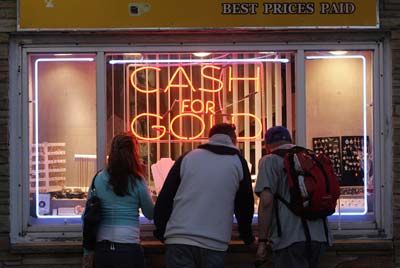
![]() Pawnshops can be found in nearly every town, big or small. See more pawn shop pictures. |
There are three things that happen in any pawnshop hundreds of times every day:
- People borrow money by putting up something they own as collateral.
- People sell used merchandise.
- People buy new and used merchandise.
What's the Deal?
|
|
- You bring in something you own and give it to the pawnbroker as collateral for a loan (this act is called pawning).
- The pawnbroker loans you money against that collateral.
- When you repay the loan plus the interest, you get your collateral back.
- If you don't repay the loan, the pawnbroker keeps the collateral.
In the next section we'll discuss an example of a pawn shop transaction.
How Much Will You Give Me...
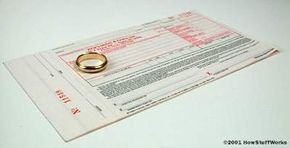
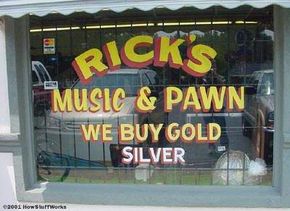
To try this out, I went to Rick's Music & Pawn and asked, "How much will you loan me for my wedding ring?"It's a nice wedding ring -- a standard gold ring with my wife's name and our wedding date engraved inside. Bought new in 1994, the ring cost about $140.
![]() Your jewelry might hold special value to you, but you'd be surprised to learn of what little value it is in a pawnshop. |
The answer was, "$10."
In return for pawning my wedding ring, I would receive $10 and a pawn ticket. The ticket would indicate the following:
- The item that I pawned
- The amount of money loaned to me for the item
- The amount of money due in 30 days to get the item back
My ticket would tell me that, for my wedding ring, I received $10 and that I need to pay $12.20 (that's 2 percent interest plus 20 percent in fees on my $10) in 30 days to get the ring back. Within 30 days, I have three options:
- I can return to the pawn shop and pay the full amount ($12.20 in this case) to retrieve my wedding ring.
- I can return to the pawn shop and pay the monthly fee ($2.20 in this case) to extend my loan for another 30 days. At this point, I'd have to enter into a new contract for the next 30 days. Here's where some pawnshops differ on the second-month contract: Some would make you pay 22 percent on the new principal, $12.20, (for a total of $14.88), while other pawnshops will allow you to continue paying 22 percent on the original principal.
- I can do nothing, in which case the pawnshop keeps my ring and sells it.
That, in a nutshell, is the basic pawnshop transaction. In a busy pawnshop, that sort of transaction happens hundreds of times every day. In many communities, the pawnshop is pretty much the only easy way to borrow small amounts of money. If you need $100 to make it through the week to your next paycheck, where are you going to get the money? A bank is not going to touch a small loan like that, and even if it did it would take a week or two to process the application. A pawnshop is a quick, easy way to get a loan.
Of course, $2.20 fees due in 30 days for a $10 loan is a pretty steep rate. That's 264 percent per year! Let's take a look at how a business can legally charge that type of interest.
Is This Information Correct?
Pawnshops are regulated at the state level in the United States, and every state has different rules. Some of the details are absolutely fascinating! As an example, let's take a look at how a pawnshop works in the state of North Carolina.
|
The next day, you come in, looking for stuff stolen from your home, and see your TV. You immediately tell the pawnbroker that that's your TV (you, of course, have the serial number), that it was stolen from your home and that you want to know who brought it in. By law, the pawnbroker cannot tell you who brought it in, or even when the TV was brought in and sold. He will direct you to the police, who will have the item ticket from the pawnshop and who will be able to investigate your claim further. |
When you pawn an item, the pawnbroker takes your name and address, verifies it with your valid driver's license and then inspects the item carefully. Most pawnshops have the ability to test diamonds and gold for authenticity. If you are bringing in something like a TV or VCR, the pawnbroker tests it to make sure it works properly. If there is a serial number on the item, it's also recorded on the pawn ticket. In the next section we'll examine the reasons a pawnshop must complete paper work on each item.
Paper Work
As we mentioned in the last section a pawn shop must complete a lot of paper work for each item they acquire. There are three reasons for this level of scrutiny:
- Every day, the pawnbroker must submit a list of all merchandise received, including serial numbers, to the police. The police compare the serial numbers against records of stolen merchandise. Anything stolen is recovered this way and returned to the owner. Why do they do this? If a stolen item is found in a pawnshop and the item was not reported to the police by the pawnshop when it came in, the pawnbroker can be charged with receiving stolen merchandise.
- According to Ausley, a typical item pawned at a pawnshop has about a 60-percent chance of being reclaimed by the person who pawned it. This means there's about a 40-percent chance that the pawnbroker will have to sell the item to recover the loan, so the item must be in a condition to be resold.
- Unlike someone running a garage sale or a booth at a flea market, a pawnbroker is running a stable business in the community and has to worry about his or her reputation. A pawnbroker cannot sell junk.
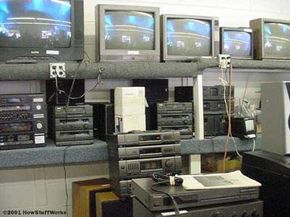
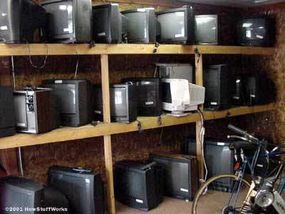
![]() This is the part of the store you can see ... |
![]() ... and this is the part you don't see. |
Interest Rate
What about the interest rate? In North Carolina, the maximum interest rate that a pawnshop can charge is 2 percent per month, or 24 percent per year. That's about the same as some credit cards. However, a pawnshop can also tack on other charges, such as handling, appraisal, storage and insurance fees. The maximum allowed charge for these additional fees is 20 percent per month. In addition to the 20-percent cap (which does not include the 2-percent interest cap), there are the following total (interest plus fees) limits:- First month - $100.00
- Second month - $75.00
- Third month - $75.00
- Fourth to six months - $50.00
Smart Business
From the pawnbroker's standpoint, a pawnshop is simply a business. According to Ausley, the idea is to "loan out about one-third of what I think I can get for the item when I sell it." If an item is priced at $100 new, and the pawnbroker thinks it will sell for $60 used, then the loan amount would be $20. The pawn ticket for this item would ask for $24.40 (2 percent interest plus 20 percent in other fees) in 30 days.Part of the art of being a pawnbroker is having a sixth sense about how much things are worth both new and used. "When you are starting out, there are books you can use, but those books are no good," says Ausley. As an experienced pawnbroker, Ausley gets most of his information about prices by walking around stores and looking at catalogs, and also by talking with other pawnbrokers. The real experience comes from buying and selling things every day. He's been in the business for 15 years.
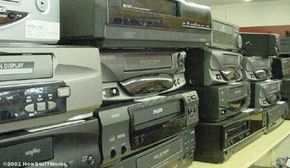
![]() When they first came out in the mid 1980s, VCRs were pretty expensive. Today, you can buy a used one for less than $40! |
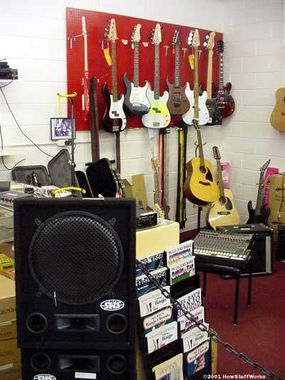
![]() Joining a rock band? Before you spend money on a new Fender electric guitar, check the instrument supply at your local pawnshop! |
Electronics are a special problem. The prices for new electronics are falling constantly, meaning that used prices are also falling. When the economy is down, lots of people are pawning things and not many people are buying. This helps to explain the high interest rates to some extent. The pawnbroker has real cash going out the door when he makes a loan, but has only the used merchandise to sell to recover that money if the loan is not repaid. Used merchandise is not the Rock of Gibraltar when it comes to investment vehicles.
"An ideal customer is someone who comes in and pays the interest every 30 days, or picks up their item every month and repawns it if necessary," says Ausley.
Incredible Bargains!
Because many of the people never pick up the items they pawn, a pawnshop is a consumer store as much as it is a lending institution. People also come in and sell used items outright to the pawnshop.
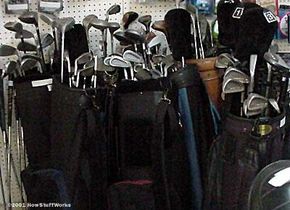
![]() For a beginning golfer, or for the golfer with a discriminating eye, pawnshops can give great deals on clubs. |
This makes any pawnshop a huge, daily garage sale! Some of the things you typically find in a pawnshop include:
- Electronics
- Tools
- Lawn equipment
- Sporting goods
- Clothing
- Musical instruments
- Jewelry
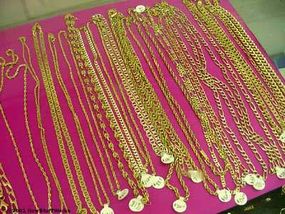
![]() Although you can get great deals on jewelry at a pawn shop, you have to know how to pick a "diamond in the rough." |
According to Ausley, "a pawnshop is a great place to buy jewelry!" You generally pay about half the retail value. Worried about authenticity? Bring an appraiser with you. Since jewelry is often the most valuable thing a person owns, it is one of the most commonly pawned items.
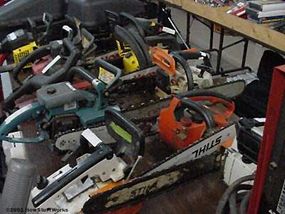
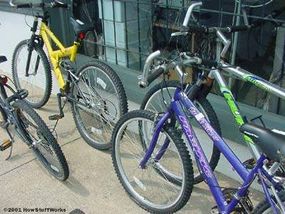
You will also find random things you might not expect to see at a pawnshop -- saddles, for example. And wheel chairs, motorcycle leather, bicycles...
![]() |
![]() From chain saws to bicycles, you'd be amazed at the random things you can find at a pawnshop! |
Often, a pawnshop has a specialty, and the shop sells new merchandise in that area. For example, Rick's Music & Pawn sells both new and used instruments, speakers and other music-oriented items.
Anything of value that you can find at a garage sale is probably for sale at a pawnshop near you. Be sure to haggle!
For more information on pawnshops and related topics, check out the links on the next page.
Lots More Information
Related HowStuffWorks Articles
- How Banks Work
- How Credit Cards Work
- How Lotteries Work
- How Anti-shoplifting Devices Work
- How Lock Picking Works
- How Recessions Work
- How College Financial Aid Works
- What are the differences between the various "chapters" of bankruptcy?
- How much money is "all the money in the world"?
More Great Links
- National Pawnbrokers Association (U.S.)
- National Pawnbrokers Association (U.K.)
- North Carolina Pawnbrokers Modernization Act of 1989
- The History of Pawnbroking
- Pawnbroking Facts