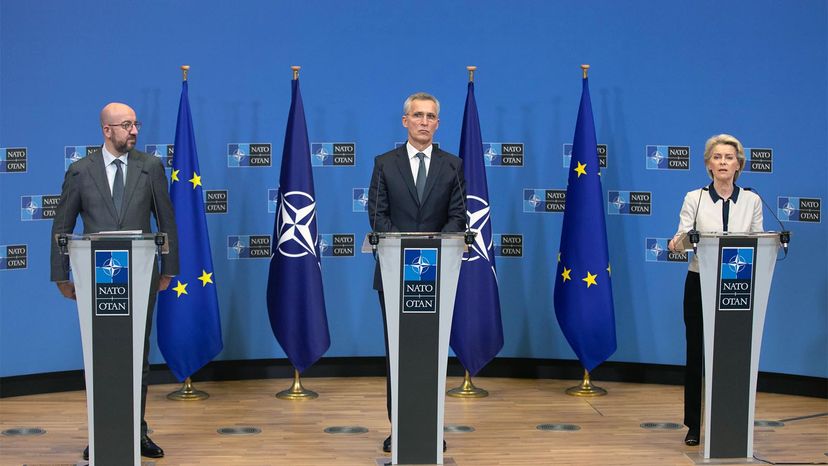
(L-R) President of the European Council Charles Michel, NATO Secretary-General Jens Stoltenberg, and President of the European Commission Ursula von der Leyen meet with the press Feb. 24, 2022, to discuss the ongoing Russian-Ukraine crisis. NATO
The North Atlantic Treaty Organization (NATO) is a global organization that serves many purposes in the world's security. NATO was formed April 4, 1949, with the signing of the North Atlantic Treaty by 12 founding member countries. The goal was to create a "pact of mutual assistance" to challenge any possibility that Joseph Stalin and the Soviet Union would try to further extend control of Eastern Europe.
But the cornerstone of NATO is what's called collective defense. It is the basis of Article 5 of NATO's founding treaty and commits members to protect each other during acts of war.
"The Parties agree that an armed attack against one or more of them in Europe or North America shall be considered an attack against them all and consequently they agree that, if such an armed attack occurs, each of them, in exercise of the right of individual or collective self-defence recognized by Article 51 of the Charter of the United Nations, will assist the Party or Parties so attacked by taking forthwith, individually and in concert with the other Parties, such action as it deems necessary, including the use of armed force, to restore and maintain the security of the North Atlantic area. Any such armed attack and all measures taken as a result thereof shall immediately be reported to the Security Council. Such measures shall be terminated when the Security Council has taken the measures necessary to restore and maintain international peace and security."
But there's much more to NATO than just Article 5 and the idea of collective defense. Keep reading to learn about this powerful organization and its important role in the world's political landscape.
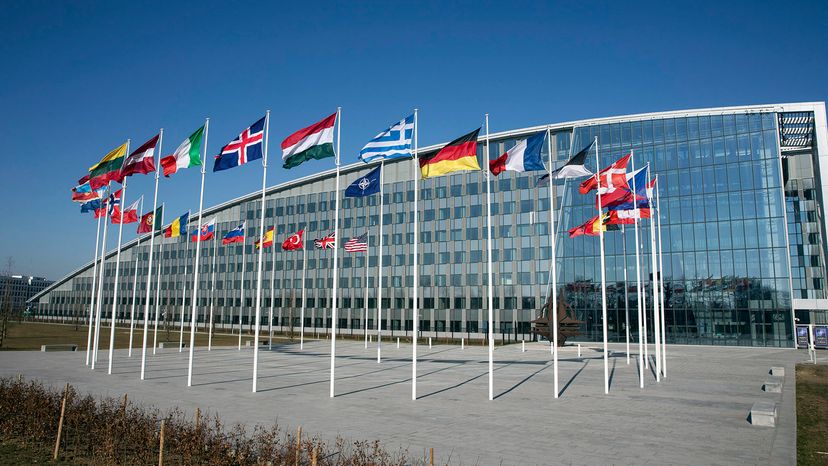
NATO headquarters is located in in Brussels, Belgium, and serves as its political and administrative center. NATO
As we mentioned previously, NATO is the acronym for the North Atlantic Treaty Organization, an alliance of 31 independent countries that work together to implement the North Atlantic Treaty. NATO's 12 founding member countries include the U.S., Canada, the United Kingdom, France, Italy, Portugal, Norway, Denmark, Iceland, Belgium, the Netherlands and Luxembourg. Greece and Turkey joined in 1952, followed by West Germany in 1955. Spain joined in 1982.
After the collapse of the Soviet Union in 1991, several Eastern European countries joined, including the Czech Republic, Hungary and Poland in 1999; Bulgaria, Estonia, Latvia, Lithuania, Romania, Slovakia and Slovenia in 2004; and Albania and Croatia in 2009. Montenegro and North Macedonia were the last two countries to join in 2017 and 2020 respectively [source: NATO].
Advertisement
When the founding members drafted the original treaty, there were disagreements on how many countries should join. The United Kingdom wanted to keep the NATO small and strong, but the United States wanted to include smaller, weaker countries — those more likely to succumb to the Soviets. France was most concerned with protecting its colonial territories, and Germany was a concern to all three countries [source: NATO].
Today, countries don't have to be members to work with NATO, however. Partnerships with non-NATO countries started back as far as 1991. The goal is to help these non-member nations become stable and democratic, with modern armed forces. Three partner countries have declared interests in NATO memberships: Bosnia and Herzegovina, Georgia and Ukraine. Today, any European country can join NATO as long as it accepts the commitments and obligations of membership (more on that shortly).
Since 2016, for instance, Ukraine has worked with NATO through the Comprehensive Assistance Package and receives support of NATO allies according to NATO standards. This type of NATO cooperation is crucial to Ukraine's the ongoing democratic transition. In September 2020, Ukrainian President Volodymyr Zelenskyy approved Ukraine's new National Security Strategy, which provides a distinctive partnership with NATO with the aim of becoming a nation member.
Finland is the latest country to join the NATO alliance. All 30 NATO countries ratified Finland's membership March 30, 2023, and the nation became the 31st member of NATO April 4, 2023, during a two-day meeting of Allied Foreign Ministers.
NATO headquarters is located in Brussels, Belgium, and serves as its political and administrative center. Representatives from member countries, as well as civilian and military experts, work there daily consulting on global security issues. More than 5,000 meetings are held there annually. All decision-making at NATO is done by consensus, which is a central value that was included in the creation of NATO in 1949.
Consensus decision-making means that there is no voting at NATO. Instead, discussions take place until all 31 member nations can come to an acceptable solution — and then it is deemed a NATO decision. Often that means some member nations "agree to disagree." The job of leading the consensus decision-making process falls to the NATO secretary-general [source: NATO].
The North American Treaty
The North Atlantic Treaty was written and signed in 1949. It arose because of the growing strength of the Soviet Union after World War II (which ended in 1945). Right after the war, the Soviet Union consolidated itself under communism and strengthened its armies. At the same time, Europe was exhausted and in shambles. The United States implemented the Marshall Plan in 1948 to help rebuild Europe, but the European countries would not have the strength to fight against the Soviets. The United States and Canada would be needed to provide the force necessary to counter any attack from the Soviet Union.
Advertisement
How Is NATO Structured?
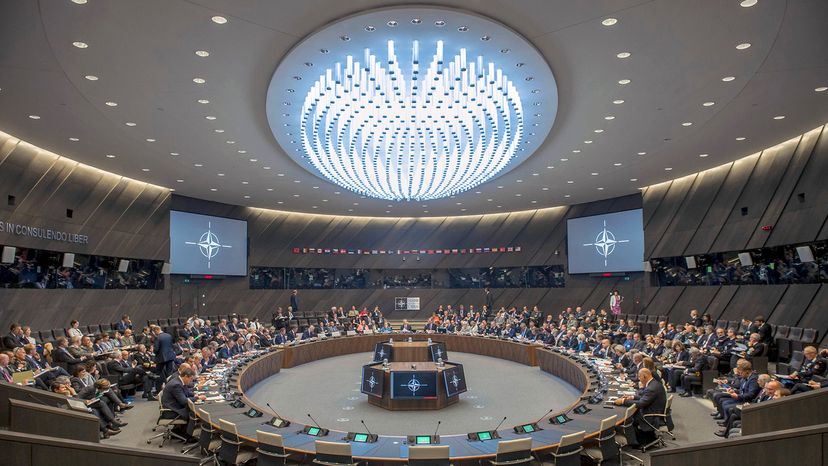
The North Atlantic Council (NAC), seen here meeting during a Defense Ministers' Session, is the main political decision-making body at NATO. NATO
There are 31 member nations that make up NATO. Each member country has a permanent delegation at NATO's headquarters in Brussels. An ambassador heads up every nation's delegation and this ambassador represents his/her government in NATO's consensus decision-making process. Linda Thomas-Greenfield is the current U.S. ambassador to NATO.
Each member nation has a seat on the North Atlantic Council (NAC), the main political decision-making body at NATO. The NAC is chaired by the secretary-general and meets at least once a week or as necessary. The Nuclear Planning Group has similar authority to the NAC, but only on matters regarding nuclear policies [source: NATO].
Advertisement
If decisions of the alliance have military implications, the Military Committee is brought in. The Military Committee is NATO's senior authority on all things military. It's the oldest committee in NATO after the NAC, and its primary responsibility is to advise the NAC and the Nuclear Planning Group, making it an essential link between NATO's political decision makers and its military structure. The Military Committee also prepares long-term assessments on countries and areas considered risks to NATO's interests.
How Is NATO Funded?
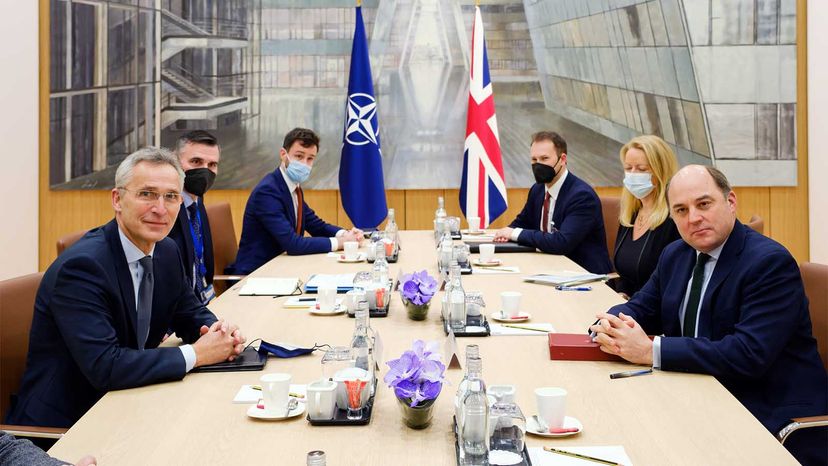
NATO Secretary-General Jens Stoltenberg (far left) meets with the Defense Minister of the United Kingdom, Ben Wallace, (far right) and his team at NATO Headquarters. NATO
Former U.S. President Donald Trump consistently accused America's NATO allies of falling behind on their "bills." Trump regularly suggested many NATO countries fell short of the financial commitment to NATO, and implied those countries should reimburse the U.S. But was he correct? Well, not completely.
Here's how NATO funding works. According to NATO's official guidelines, member nations are expected to commit a minimum of 2 percent of their Gross Domestic Product (GDP) to spending on defense — meaning payments made by the government specifically to meet the needs of its armed forces. In 2014, just three members spent 2 percent of their GDP or more on defense; by 2020 that number was up to 11. NATO says the majority of member nations plan to meet this goal by 2024.
Advertisement
The United States far exceeds the 2 percent guideline, paying more than 3.5 percent of its GDP, the most of any member nation.
It's worth noting the 2 percent of GDP is still only a guideline and there is no penalty to countries that don't meet it. In 2017, 22 of 28 member nations followed through with the 2 percent pledge and did increase their defense budgets [source: Kottasová]. But some smaller countries simply don't have the armies large enough to handle such huge increases, and the 2 percent GDP funding does not have to cover only defense to meet NATO requirements.
So what does all that money go to fund? More on that next.
Advertisement
NATO's Missions and Operations
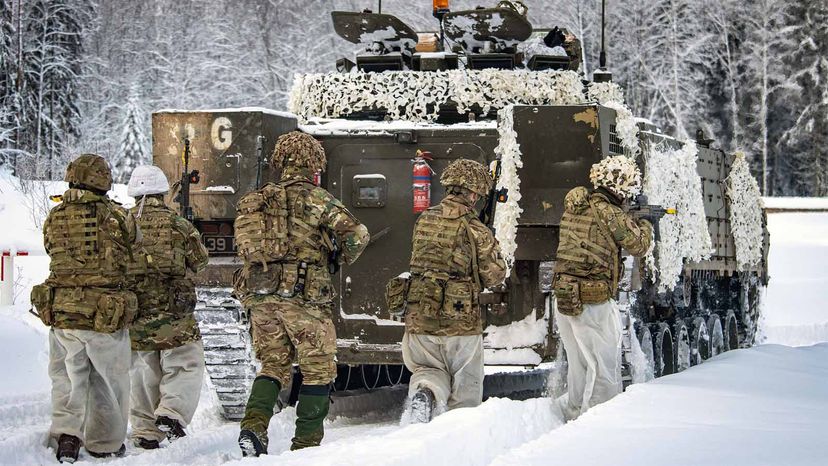
Units from eFP Battlegroup Estonia participate in an attack as part of the NATO battlegroup winter exercise in Estonia in February 2022. NATO
NATO takes active roles in many types of operations and missions across the globe. The organization is a leader in contributing to peace and security, promoting democratic values and resolving international disputes. It also has military capabilities to intercede — alone or with other countries — whenever and wherever necessary.
NATO currently has 20,000 military personnel working on missions around the world. NATO is leading operations in Kosovo and the Mediterranean, and is also supporting the African Union, conducting air patrols over the Baltic States and air defense activities in Turkey. But NATO also is there when disaster strikes, helping with relief operations during natural, technological and humanitarian crises.
Advertisement
To ensure NATO can act on any given day to any given crisis, it maintains a modern defense plan based on an two key safeguards: cutting-edge weapons systems and forces trained to work together [source: NATO]. That means investing in the right mix of nuclear, conventional and ballistics missile defense capabilities remains core to NATO's overall strategy. And that costs big bucks — the 30 member nations (before Finland joined) spent an estimated $1.2 trillion on defense in 2021, more than $811 billion of that was by the U.S.
So does the world still need NATO? Some say its obsolete. But during a time when there is deep uneasiness, and Russia is invading Ukraine, other nations disagree. NATO Secretary-General Jens Stoltenberg on Feb. 24, 2022, announced that NATO will send troops to Eastern Europe to aid Ukraine, but did not provide additional details. He said the alliance had activated defense plans to help ensure that there is no spillover into any NATO member country.
Stoltenberg continued:
Peace cannot be taken for granted. Freedom and democracy are contested by authoritarian regimes. And strategic competition is on the rise. We must respond. With renewed resolve. And even stronger unity. North America and Europe, together in NATO. We are an Alliance of 30 democracies. Standing as one, We will protect our people and our values. Democracy will always prevail over autocracy. Freedom will always prevail over oppression.
Donald Trump. @realdonaldtrump (July 11, 2018) https://twitter.com/realDonaldTrump/status/1016729137409486853
Kottasová, Ivana. "How NATO is funded and who pays what." CNN. May 25, 2017 (July 11, 2018) https://money.cnn.com/2017/05/25/news/nato-funding-explained-trump/index.html
NATO. "Defence Expenditures of NATO Countries (2008-2015)." (July 11, 2018) https://www.nato.int/nato_static_fl2014/assets/pdf/pdf_2016_01/20160129_160128-pr-2016-11-eng.pdf
Porter, Tom. "What is NATO and How Is it Funded?" July 11, 2018 (July 11, 2018) http://www.newsweek.com/what-nato-and-how-it-funded-1018069
Whitehouse.gov. "Remarks by President Trump and NATO Secretary General Jens Stoltenberg at Bilateral Breakfast." (July 11, 2018) https://www.whitehouse.gov/briefings-statements/remarks-president-trump-nato-secretary-general-jens-stoltenberg-bilateral-breakfast/
Cite This!
Please copy/paste the following text to properly cite this HowStuffWorks.com article: