Introduction to How NASDAQ IPOs Work
There are many different reasons that businesses need money. For example, if you want to start a new airline, you need funds to rent planes, pay for fuel and so forth in order to get the airline off the ground. Or, say you've started a moderately successful small company. To go nationwide, you need a lot of cash.

Chris Hondros/Getty Images
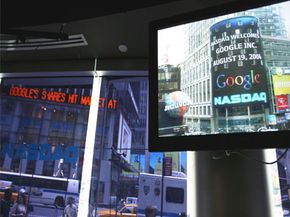
The Google logo appears on a screen and ticker inside the
NASDAQ MarketSite just before the markets closed on
Aug. 19, 2004. Shares of Google closed at 100.34, $15.34
higher than it opened.
What is an IPO?
The name "initial public offering" pretty much says it all:
|
One reason that a company does an IPO is to raise cash -- usually, lots of cash. For example, when Google did its IPO in 2004, it sold approximately 20 million shares of stock for $85 a share. In other words, Google raised about $1.7 billion dollars.
In the process of selling the stock in the IPO, the company receives a healthy chunk of money in its bank account. It can then spend that money any way it sees fit.
IPO Process
Obviously, with this large chunk of cash coming into a company, there is the possibility for fraud. To counter this, the federal government created the Securities and Exchange Commission, or the SEC.
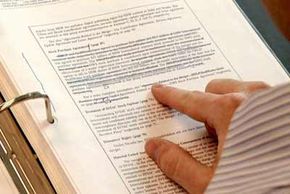
In order to go public and do an IPO, companies must have the SEC's approval. They obtain that approval by writing something called an S-1 document. In most cases the S-1 document is a full book describing exactly what the company is doing and why. Here, as an example, is Google's S-1 filing: Google, Inc. S-1 on 4/29/2004.
The SEC reads the S-1 document and then usually goes back and forth with the company to adjust it. Then the SEC either approves or denies it.

©2007 HowStuffWorks
When a company wants to go from private to public, it gathers
information into an S-1 document for the SEC to review.
The next step is to get shareholder approval. The company is a private company prior to the IPO, and it has private investors.Those investors have to vote on whether or not to create the IPO, and they use the S-1 document to gather the information they need to vote. If the existing shareholders approve the IPO, then the company can continue the process -- namely, securing investors.
Picking an Exchange
While it is filing its S-1 and getting shareholder approval, the company chooses the exchange it will electronically trade on. This is an important decision for a number of reasons. Many high-tech companies -- like Intel, Microsoft and Apple -- have traditionally chosen the NASDAQ stock market. Today, the type of company choosing the NASDAQ is much broader because the exchange has been so successful. Most would not consider Starbucks coffee to be "high-tech" per se, but it is listed on the NASDAQ nonetheless.
In picking its exchange, the company also picks its trading symbol. Microsoft trades under MSFT. Starbucks is SBUX. A new company picks its symbol often as an abbreviation of its name, but it sometimes gets creative, too. For example, the cell phone company Brightpoint uses the symbol CELL.
The company pays NASDAQ about $160,000 per year to be listed on its exchange.
IPO Sales

Photo courtesy Chris Hondros/Getty Images
When Krispy Kreme had its IPO on the
NASDAQ stock index, shares opened
11 points higher than their offering price.
This may seem odd. It would seem that, in the IPO, the shares would be offered to the general public. But in most cases they're not. Large investors and investment banks buy big blocks of stock after private conversations with the company. They pay for the stock with big chunks of cash.
So what happens on the actual morning of the IPO? The money from the big investors flows into the company's bank account, and the big investors start selling their shares at the public exchange. All the trading that occurs on the stock market after the IPO is between investors; the company gets none of that money directly. The day of the IPO, when the money from big investors hits the corporate bank account, is the only cash the company gets from the IPO.
The fact that investors start trading the stock on the morning of the IPO controls the offering price in the IPO. The company can choose any price for its initial shares. If the company chooses a price that is too low, it leaves money on the table. The price of the stock will jump up as soon as people start trading it. But if it chooses a price that is too high, the opposite happens. The stock price falls, and that can leave a stain on the company's reputation. Therefore, companies and their bankers spend lots of time considering the IPO price.
When the money hits the bank account, it is a little less than the total raised in the IPO. For example, the company might get 92 percent of the money. The other 8 percent goes to pay the people who helped usher the IPO through the process: law firms, accountants and the primary investment bank that handled the IPO.
Still, the company receives a huge amount of cash -- cash it can now use to grow the business.
On the morning of the IPO, the NASDAQ exchange often has an IPO ceremony. Executives, employees and family members from the company come to the NASDAQ studio at Times Square to celebrate the IPO at the opening bell. The CEO signs in and the event is broadcast on the NASDAQ MarketSite tower in Times Square as well as on TV networks around the world. On that day, the company morphs into a publicly traded entity and starts a new phase in its corporate history.
Lots More Information
Related HowStuffWorks Articles
- How NASDAQ Works
- How NASDAQ's Opening and Closing Cross Works
- How the NASDAQ MarketSite Works
- How the NASDAQ MarketSite Tower Works
- How Electronic Trading Works
- How Stocks and the Stock Market Work
- How Banks Work
- How Currency Works
- How the Fed Works
- How Recessions Work
More Great Links