Introduction to How the Freecycle Network Works
![]() Courtesy Freecycle Network |
In this article, we'll find out how the Freecycle Network got started, how the process works and how you can start giving your unwanted stuff away to people who'll use it.
Freecycle Basics
|
|
If you're thinking, "Sweet, presents!", think again -- according to the official Web site, your local Freecycle group is not a place to just grab up "free stuff for nothing." A gift economy is a two-way street. Don't take it if you don't need it, and remember that it's a gift, not a freebie. If you're looking to get something for nothing, you should probably just check out the "Free" section of your local Craig's list or newspaper.
Freecycle is an idealistic endeavor, to be sure, but it's working. The network was born in 2003 in Arizona, the brainchild of Deron Beal. Beal worked for an environmentalist group in Tucson, trying to keep usable goods out of landfills through education. The nonprofit he worked for had a bunch of office supplies it didn't need, and Beal spent hours locating other nonprofit groups that needed what his group was trying to give away. He realized he could easily set up a listserv where people could see what was available and what was needed and save everyone a lot of time in the process. Thus began Freecycle.
In December 2005, there are more than 1.8 million members in 3,200 Freecycle communities in 50 countries around the world. The Freecycle Network reports that its members are keeping 55 tons of goods out of landfills each day. Let's find out how it works.
The Freecycle Process
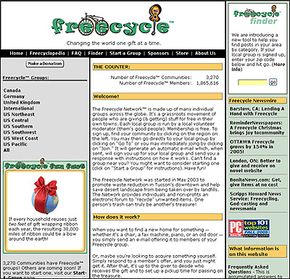
Joining a Freecycle group takes about two minutes. You visit Freecycle.org and click on the link for your region.
![]() Courtesy Freecycle Network Freecycle.org homepage |
The next page lists all of the Freecycle groups in that region. In the U.S. Central region, for example, there are 833 groups as of December 2005. So you look for a group in your area. If there's no group near you, you can actually start one up (see "Starting Your Own Freecycle Group" below). If there is already a group in your city or town, you can click on its "GoTo" link to visit the Web page for that group or just click on "Join" to register. Some groups require membership approval. If your local group does, you just fill out a few profile details and write a short message explaining why you want to join. The volunteer moderator for that group approves your membership and sends you a series of e-mails explaining how the process works.
|
Let's say we have an old printer just collecting dust in the closet. Our local Freecycle group might want it, so we'll offer it to our fellow group members. The system is pretty simple:
- To post an offer, we'll send an e-mail to the group's e-mail address or visit the group Web site and click on "Messages." The subject line of our message should be short an simple: "OFFER: Item, general location" is the framework. So our e-mail subject will read "OFFER: Working HP inkjet printer, 15th and Main."
- Once we receive a response, meaning one of our group members wants it, we set up a way to deliver the gift. We can set up any delivery method that works for us. We might give the receiver our address and leave the gift on the porch; we could meet at the mall parking lot and hand over the printer in front of Macy's; we could bring the gift to our workplace and ask the receiver to meet us there. The one thing to keep in mind besides convenience is safety: If it's raining and you can't leave the printer on your front porch, it's probably not a good idea to leave it in your garage and give a perfect stranger your garage door entry code. Just wait until it stops raining.
- Once the interested party picks up the printer, we send out another e-mail with the subject line "TAKEN: Working HP inkjet printer, 15th and Main." One good thing about the Freecycle listserv is that while offers go out to every member in the group, responses come only to the member who made the offer. This saves a lot of inbox space, but it also means we need to let everybody know the printer is no longer available so we don't get any more responses for it.
And that's it! A few e-mails, a short exchange with a fellow member and you get to feel all warm and fuzzy inside. Everybody wins -- so it might seem strange that many people are angry with the Freecycle Network for what they perceive as the corruption of a good thing.
|
|
The Freecycle Future
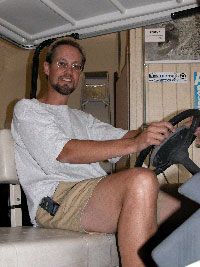
![]() Photo courtesy Jimmy Boegle, Tucson Weekly Deron Beal, founder of Freecycle |
First, Deron Beal is taking flak for what his volunteer moderators see as micromanaging. Moderators used to have exclusive "ownership" of their local group, but in 2004, Beal decided that every local group should add him as an owner with moderator privileges. According to Beal, it was necessary because some moderators had simply stopped moderating and there had to be a way to pick up the slack. Many members want Freecycle to remain a loose, grassroots network with no centralized control, but Beal seems to have other plans. His fight to defend the trademarked "Freecycle" has alienated part of his anti-consumerism, anti-big-business base. A visit to the Freecycle Web site lets everybody know that "Freecycle" is an adjective and only an adjective. Media representatives are not supposed to use the word "Freecycle" as a noun, a verb or any other form of speech. We can't say "Freecycling," "Freecycler" or "Freecycle it," lest the word become generic. (Avoiding these words is harder than it may seem!)
The other point of contention has to do with the Freecycle Network's sudden corporate sponsorship. In 2005, Beal accepted $130,000 in grant money from the Waste Management (WM) garbage-collection company. Many members of the Network are happy to receive the gift from WM. The problem is that WM has a very poor environmental record, raising questions as to whether the partnership is really a good fit. And in any case, some members of the Freecycle Network were unhappy to learn that their grassroots movement had received a lot of money from the largest waste-collection business in the United States. Several local Freecycle groups left the network and started their own gifting group, abandoning the Freecycle name. One such spinoff is FreeSharing.org, which states on its homepage, "The sites featured on FreeSharing.org are 100% locally owned, grassroots sites, working to help their neighbors and the environment." FreeSharing.org uses the term "Free-Recycling" to describe its activities.
Regardless of the apparent strife within the Freecycle ranks, the movement is still going strong. It plans to expand its operation until it has a presence in every town in every country in the world. Future plans include local education programs to teach people about recycling and waste reduction, and part of the WM grant money will be used to leave Yahoo! Groups and set up independent Web sites that allow for new organization techniques and search tools. The goal is to ease the burden on local moderators and allow for more automation and organization in the gifting process.
For more information on the Freecycle Network and related topics, check out the links on the next page.
Lots More Information
Related HowStuffWorks Articles
- How eBay Works
- How Ecolodges Work
- How Landfills Work
- How The Nature Conservancy Works
- How Philanthropy Works
- How the World Wildlife Fund Works
More Great Links
- BusinessWeek Online: What's Up (or Down) at Freecycle?
- Freecycle.org
- FreeSharing.org
- Grist.org: Give It Away, Give It Away, Give It Away Now
- Grist.org: Waste Lines
Sources
http://groups.yahoo.com/group/BoulderCOFreecycle/
http://www.freecycle.org/
http://www.businessweek.com/the_thread/techbeat/archives/2005/08/whats_up_at_fre.html
http://www.usatoday.com/life/lifestyle/2004-12-20-freecycling_x.htm
http://www.grist.org/news/maindish/2004/05/17/nijhuis-freecycle/index.html
http://ottawa.freecyclecanada.org/bg.htm
http://www.grist.org/news/maindish/2005/05/19/weiser-freecycle/index.html